 |
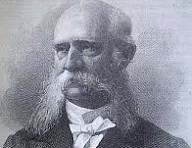
| U.S. Navy Lt. S.L. Phelps (in
1885) |
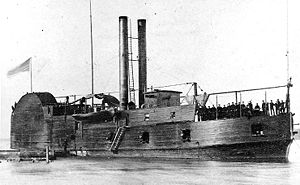 |
| USS Conestoga |
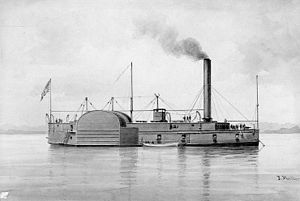 |
| U.S.S. Lexington |
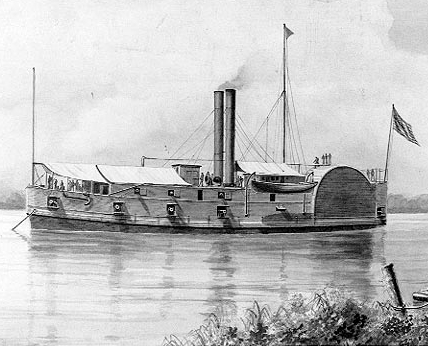 |
| U.S.S. Tyler |
|
After the fall of Fort Henry on Feb. 6, 1862, Lt. Cdr. Seth Phelps, in charge of the three "timberclads" Lexington, Tyler, and Conestoga,
was sent on a raid up (southwards) the Tennessee River. This raid
was one of the most immediate consequences of the loss of Fort Henry,
as it demonstrated how deep into the western Confederacy the Federals
could go, using the Tennessee as a highway. Presented here is the
full report by Phelps, who went on to a distinguished career in the
Navy and elsewhere. The report may be found in Vol. VII of The Official Records, pp. 153--56. A biography of Phelps exists: Ironclad Captain: Seth Ledyard Phelps and the U.S. Navy, 1841-1864, Kent State University Press, 1997. |
|
|
U.S. GUNBOAT CONESTOGA,
Tennessee River, February 10, 1862. SIR: Soon after the surrender of Fort Henry, on the 6th
instant, I proceeded, in obedience to your orders, up the Tennessee River, with
the Tyler, Lieutenant-Commander Gwin; Lexington, Lieutenant-Commander Shirk,
and this vessel, forming a division of the flotilla, and arrived after dark at
the railroad crossing, 25 miles above the fort, having destroyed on the way a
small amount of camp equipage abandoned by the fleeing rebels. The draw of the
bridge was found closed and the machinery for turning it disabled. About 1½
miles above were several rebel transport steamers escaping upstream. A party
was landed, and in one hour I had the satisfaction to see the draw open. The
Tyler being the slowest of the gunboats, Lieutenant-Commander Gwin landed a
force to destroy a portion of the railroad track and to secure such military
stores as might be found, while I directed Lieutenant-Commander Shirk to follow
me with all speed in chase of the fleeing boats. In five hours this boat
succeeded in forcing the rebels to abandon and burn three of these boats,
loaded with military stores. The first one fired (Samuel Orr) had on board a
quantity of submarine batteries, which very soon exploded. The second one was
freighted with powder, cannon shot, grape, balls, &c. Fearing an explosion
from the fired boats---there were two together---I had stopped at
a distance of 1,000 yards, but even there our skylights were shattered by the
concussion, the light upper deck was raised bodily, doors were forced open, and
locks and fastenings everywhere broken. The whole river for half a mile around
about was completely "beaten up" by the falling fragments and the
shower of shot, grape, balls, &c. The house of a reported Union man was
blown to pieces, and it was suspected there was design in landing the rebels in
front of the doomed house. The Lexington having fallen astern, and being without a
pilot on board, I concluded to wait for both of the boats to come up. Joined by
them, we proceeded up the river. Lieutenant-Commander Gwin had destroyed some
of the trestle work of the end of the bridge, burning with them a lot of camp
equipage. I.N. Brown, formerly a lieutenant in the Navy, now signing himself
"Lieutenant, C. S. N.," had fled with such precipitation as to leave
his papers behind. These, Lieutenant. Commander Gwin brought, and I send them
to you, as they give an official history of the rebel floating preparations on
the Mississippi, Cumberland, and Tennessee. Lieutenant Brown had
charge of the construction of gunboats. At night on the 7th we arrived at a landing in Hardin
County, Tennessee, known as Cerro Gordo, where we found the steamer Eastport
being converted into a gunboat. Armed boat crews were immediately sent on board
and search made for means of destruction that might have been devised. She had
been scuttled and the suction pipes broken. These leaks were soon stopped. A
number of rifle shots were fired at our vessels, but a couple of shells
dispersed the rebels. On examination, I found that there were large quantities
of timber and lumber prepared for fitting up the Eastport; that the vessel
itself---some 280 feet long---was in excellent condition, and already half
finished. Considerable of the plating designed for her was lying on the bank,
and everything at hand to complete her. I therefore directed
Lieutenant-Commander Gwin to remain with the Tyler, to guard the prize, and to
lead the lumber, &c., while the Lexington and Conestoga should proceed
still higher up. Soon after daylight on the 8th we passed Eastport, Miss.,
and at Chickasaw, farther up, near the State line, seized two steamers, the
Sallie Wood and Muscle, the former laid up, the latter freighted with iron
destined for Richmond and for rebel use. We then proceeded on up the river,
entering the State of Alabama, and ascending to Florence, at the foot of the
Muscle Shoals. On coming in sight of the town three steamers were discovered,
which were immediately set on fire by the rebels. Some shots were fired from
the opposite side of the river below. A force was landed and considerable
quantities of supplies, marked "Fort Henry," were secured from the
burning wrecks. Some had been landed and stored. These I seized, putting such
as we could bring away on board our vessels and destroying the remainder. No
flats or other craft could be found. I found also more of the iron plating
intended for the Eastport. A deputation of citizens of Florence waited upon me, first
desiring that they might be made able to quiet the fears: of their wives and
daughters with assurances from me that they should not be molested, and
secondly praying that I would not destroy their railroad bridge. As for the
first, I told them that we were neither ruffians nor savages, and that we were
there to protect them from violence and to enforce the law; and
with reference to the second that, if the bridge were away, we could ascend no
higher, and that it could possess, so far as I saw, no military importance, as
it simply connected Florence itself with the railroad on the south side of the
river. We had seized three of their steamers, one the half-finished gunboat,
and had forced the rebels to burn six others loaded with supplies, and their
loss, with that of the freight, is a heavy blow to the enemy. Two boats are
still known to be on the river, and are doubtless hidden in some of the creeks,
where we shall be able to find them when there is time for the search. We returned on the night of the 8th to where the Eastport
lay. The crew of the Tyler had already gotten on board of the prize an immense
amount of lumber, &c. The crews of the three boats set to work to finish
the job immediately, and we have brought away probably 250,000 feet of the best
quality of ship and building timber, all the iron machinery, spikes, plating,
nails, &c., belonging to the rebel gunboat, and caused the mill to be
destroyed where the lumber had been sawed. Lieutenant-Commander Gwin, in our absence, had enlisted some
25 Tennesseeans, who gave information of the encampment of Colonel Crews' rebel
regiment at Savannah, Tenn. A portion of the 600 or 700 men were known to be
"pressed" men, and all were badly armed. After consultation with
Lieutenant-Commanders Gwin and Shirk, I determined to make a land attack upon
the encampment. Lieutenant-Commander Shirk, with 30 riflemen, came on board the
Conestoga. Leaving his vessel to guard the Eastport, and accompanied by the
Tyler, we proceeded up to that place, prepared to land 130 riflemen and a
12-pounder rifled howitzer. Lieutenant-Commander Gwin took command of this
force when landed, but had the mortification to find the encampment deserted.
The rebels had fled at 1 o'clock at night, leaving considerable quantities of
arms, clothing, shoes, camp utensils, provisions, implements, &c., all of
which we secured or destroyed, and their winter quarters of log huts were
burned. I seized also a large mail-bag, and send you the letters giving
military information. The gunboats were then dropped down to a point where arms
gathered under the rebel press law had been stored, and an armed party, under
Second Master Gowdy, of the Tyler, succeeded in seizing about 70 rifles and fowling-pieces. Returning to Cerro Gordo, we took the Eastport, Sallie Wood,
and Muscle in tow, and came down the river to the railroad crossing. The Muscle
sprang a leak, and, all efforts failing to prevent her sinking, we were forced
to abandon her, and with her a considerable quantity of fine lumber. We are
having trouble in getting through the draw of the bridge here. I now come to the most interesting portion of the report,
one which has already become lengthy, but I trust you will find some excuse for
this in the fact that it embraces a history of labors and movements day and
night from the 6th to the 10th of the month, all of which details I deem it
proper to give you. We have met with the most gratifying proofs of loyalty
everywhere across Tennessee, and in the portions of Mississippi and Alabama we
visited most affecting instances greeted us almost hourly. Men, women, and
children several times gathered in crowds of hundreds, shouted their welcome,
and hailed their national flag with an enthusiasm there was no mistaking. It
was genuine and heartfelt. These people braved everything to go to the river
bank where a sight of their flag might once more be enjoyed, and they have
experienced, as they related, every possible form of persecution. Tears flowed
freely down the cheeks of men as well as of women, and there
were those who had fought under the Stars and Stripes at Monterey who in this
manner testified to their joy. This display of feeling and sense of gladness at
our success and the hopes it created in the breasts of so many people in the
heart of the Confederacy astonished us not a little, and I assure you, sir, I
would not have failed to witness it for any consideration. I think it has given
us all a higher sense of the sacred character of our present duties. I was
assured at Savannah that of the several hundred troops there more than one
half, had we gone to the attack in time, would have hailed us as deliverers and
gladly enlisted with the national force. In Tennessee the people generally in
their enthusiasm braved secessionists and spoke their views freely, but in
Mississippi and Alabama what was said was guarded. "If we dared express
ourselves freely, you would hear such a shout greeting your coming as you never
heard." "We know there are many Unionists among us, but a reign of
terror makes us afraid of our shadows." We were told, too, " Bring us
a small organized force, with arms and ammunition for us, and we can maintain
our position and put down rebellion in our midst." There were, it is true,
whole communities who on our approach fled to the woods, but these were where
there was less of the loyal element, and where the fleeing steamers in advance
had spread tales of our coming with fire-brands, burning, destroying,
ravishing, and plundering. The crews of these vessels have had a very laborious time,
but have evinced a spirit in the work highly creditable to them.
Lieutenant-Commanders Gwin and Shirk have been untiring, and I owe to them and
to their officers many obligations for our entire success. I am, respectfully, your obedient servant,
S. L. PHELPS, Lieutenant-Commander,
U.S. Navy. Flag-Officer A. H.
FOOTE, |
Back to Civil War Chronologies (Main page) Back to Chronology of the Henry-Donelson-Shiloh Campaign Source: The Official Records, Vol. VII, pp. 153--56. Date added to website: August 31, 2025. |