 |
| Confederate
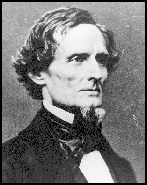
President Jefferson Davis |
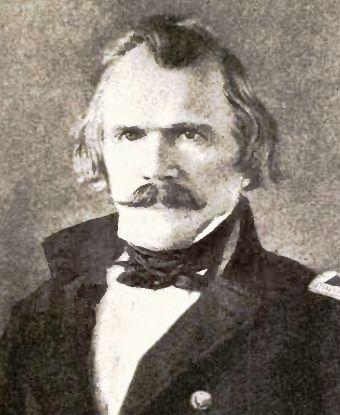 |
| Gen. A.S. Johnston |
|
Jefferson
Davis and Albert Sidney Johnston had been colleagues and friends for a
long time. They both attended Transylvania University in
Kentucky,
and were cadets together at West Point. During the Pierce
Administration (1853--57), when
Davis was Secretary of War, Johnston was promoted to command the newly
created 2nd U.S. Cavalry. Later, during the Buchanan
Administration, Johnston was put in command of the Utah expedition
against the Mormons. So, when difficulties began to mount
in his Confederate command, it was not at all surprising that Davis
sent Johnston a personal letter of support and encouragement;
nonetheless, portions of the letter call for Johnston to offer some
explanations in order to mollify public opinion.
|
|
|
RICHMOND, VA., March
12, 1862.
MY DEAR GENERAL: The departure of
Captain Wickliffe offers an opportunity of which I avail myself to write you an
unofficial letter. We have suffered great anxiety because of recent events in
Kentucky and Tennessee, and I have been not a little disturbed by the
repetition of reflections upon yourself. I expected you to have made a full
report of events precedent and consequent to the fall of Fort Donelson. In the
mean time I made for you such defense as friendship prompted and many years'
acquaintance justified, but I needed facts to rebut the wholesale assertions
made against you to cover others and to condemn my administration. The public,
as you are aware, have no correct measure for military operations, and journals
are very reckless in their statements. Your force has been magnified and the
movements of an army [measured?] by the capacity for locomotion of an
individual. The readiness of the people among whom you are operating to aid you
in every method has been constantly asserted, the purpose of your army at
Bowling Green wholly misunderstood, and the absence of an effective force at
Nashville ignored. You have been held responsible for the fall of Donelson and
the capture of Nashville. 'Tis charged that no effort was made to save the
stores at Nashville and that the panic of the people, was caused by the army.
Such representations, with the sad forebodings naturally belonging to them,
have been painful to me and injurious to us both; but, worse than this, they
have undermined public confidence and damaged our cause. A full development of the truth
is necessary for future success. I respect the generosity which has kept you
silent, but would impress upon you that the subject is not personal but public
in its nature; that you and I might be content to suffer, but neither of us can
willingly permit detriment to the country. As soon as circumstances will
permit it is my purpose to visit the field of your present operations; not that
I should expect to give you any aid in the discharge of your duties as a
commander, but with the hope that my position would enable me to effect
something in bringing men to your standard. With a sufficient force, the
audacity which the enemy exhibits would no doubt give you the opportunity to
cut some of his lines of communication, to break up his plan of campaign, and,
defeating some of his columns, to drive him from the soil as well of Tennessee
as of Kentucky. We are deficient in arms, wanting in discipline, and inferior
in numbers. Private arms must supply the first want; time and the presence of
an enemy, with diligence on the part of commanders, will remove the second, and
public confidence will overcome the third. General Bragg brings you
disciplined troops, and you will find in him the highest administrative
capacity. General E. K. Smith will soon have in East Tennessee a sufficient
force to create a strong diversion in your favor; of, if his strength cannot be
made available in that way, you will best know how to employ it otherwise. I
suppose the Tennessee or Mississippi River will be the object of the enemy's
next campaign, and I trust you will be able to concentrate a force which will
defeat either attempt. The fleet which you will soon
have on the Mississippi River, if the enemy's gunboats ascend the Tennessee,
may enable you to strike an effective blow at Cairo; but to one so well
informed and vigilant I will not assume to offer suggestions as to when and how
the ends you seek may be obtained. With the confidence and regard of
many years, I am, very truly, your friend, JEFFERSON DAVIS. |
Back to Civil War Chronologies (Main page) Back to Chronology of the Henry-Donelson-Shiloh Campaign Source: The Official Records, Vol. VII, pp. 257--58. Date added to website: August 31, 2025. |