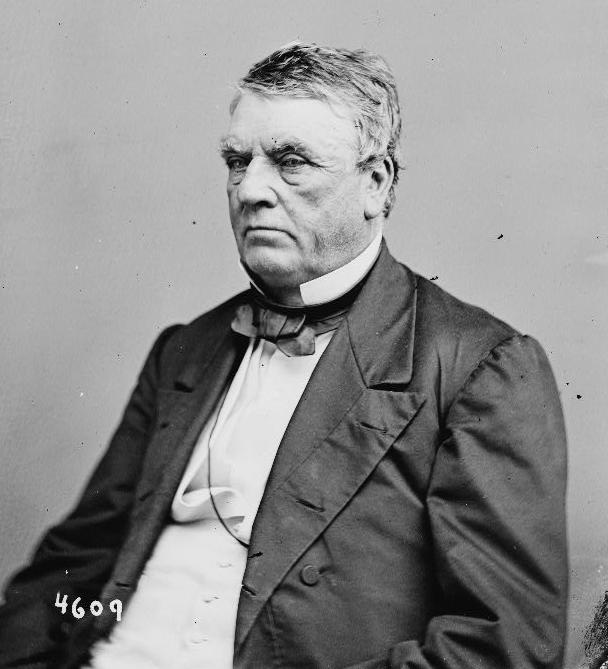
Chronology of the Fort Sumter Crisis
(including events at
Fort Pickens)
|
Sources:
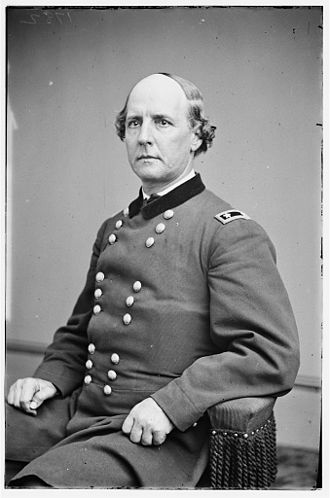
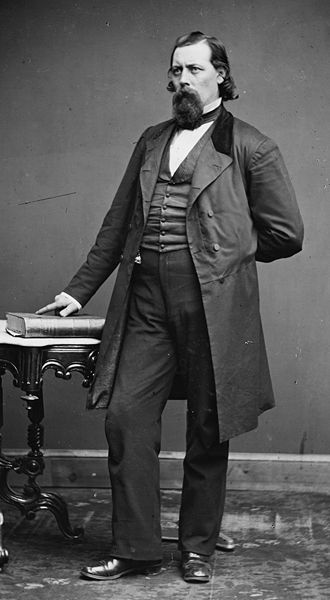
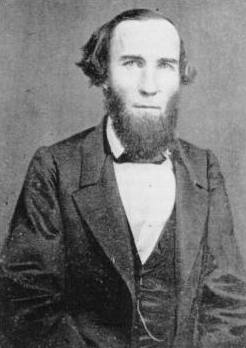
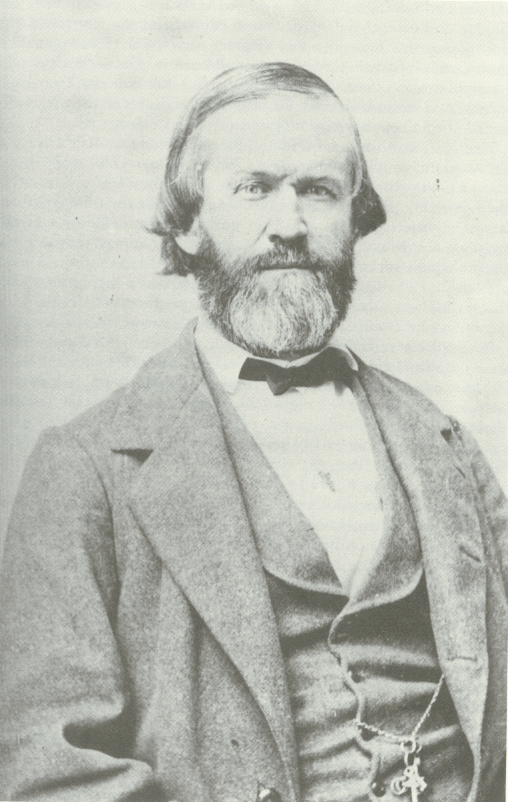
(Note: Most of the photographs of the military officers here were taken long after these events, and so they are photos of the men at a higher rank than they held at this time.) |
| Date: |
Events: |
|||||||||
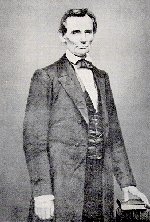
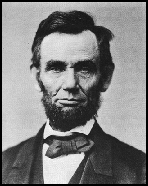
| Nov. 6, 1860 | Abraham Lincoln wins election as 16th
President of the United States. [1, pp. 109--111; 2, p. 15; 5, pp. 1--30; 6, p. 2; 7, p. 15, 21; 9, pp. 312--317; 13, pp. 442--47.] An estimated 81.2% of eligible voters cast ballots in this election. [5, p. 30; 7, p. 21.] |
|
||||||||
| Nov. 7, 1860 |
In response to Lincoln's election,
the three principal Federal officials in Charleston, Judge
A.G. McGrath, Federal District Attorney James Conner, and Port
Collector W.F. Colcock, all resign their positions.
[5, p. 25; 9, p. 318.] |
|||||||||
| Nov. 8, 1860 |
Col.
John L. Gardner, commanding United States
forces in Charleston Harbor, orders Capt. Truman Seymour, of his
command, to transfer arms from the Charleston arsenal to Fort Moultire.
The shipment is blocked by Charleston civilians.
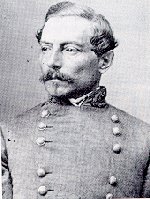
[1, pp. 141--42; 2, pp. 57--58; 4, pp. 30--31; 5, p. 99; 7, pp. 15--17; 9, p. 349.] Major P.G.T. Beauregard (of Louisiana) is appointed Superintendant of West Point. He assumes the post in January, but is almost immediately relieved of the position when Louisiana secedes on January 26, 1861. [1, p. 252; 5, pp. 234--35; 7, p. 175; 15, pp. 45--46.] |
|
||||||||
| Nov. 10, 1860 | The
South Caroline
Legislature calls for the election of a state convention; the voting
for delegates to be on Dec. 6, and the convention to open on Dec. 17. [1, p. 131; 4, p. 33; 5, p. 91; 9, p. 320; 14, p. 45.] |
|||||||||
| Nov. 11, 1860 | Capt.
Fitz-John Porter, having been sent to inspect and report upon the
situation in Charleston Harbor, recommends that the garrison be
increased, but with delicacy and discretion. [1, pp. 142--43, 12, pp. 70--72.] |
|||||||||
| Nov. 14, 1860 | Georgia
Congressman Alexander Stephens, an old friend of President-elect Lincoln's, gives
a speech to the Georgia Legislature urging caution on secession. [14, p. 144; the full text of the speech is here.] |
|
||||||||
| Nov. 15, 1860 |
Maj.
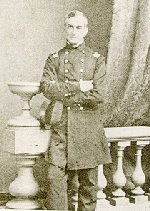
Robert Anderson is ordered to assume
command of the United States forces in Charleston Harbor, replacing
Col. Gardner.
[1, p. 143; 5, p. 99; 6, p. 5; 7, pp. 62--65; 12, p. 73; 13, p. 518; full document is given here.] |
|
||||||||
| Nov. 16, 1860 | Gov. Letcher of Virginia
calls the legistature into session on Jan. 7, 1861, partly in response
to Lincoln's election. [9, p. 411; New York Times archive; full text of Letcher's proclamation is here; 14, p. 306.] The Augusta (Georgia) Daily Constitutionaist publishes an editorial in favor of secession, but urging a cautious approach.
[Full text of the editorial may be found here.) |
|
||||||||
| Nov. 21, 1860 | Maj. Anderson arrives in Charleston. [4, p. 41; 5, p. 107.] |
|||||||||
| Nov. 23, 1860 | Anderson requests reinforcements from the War
Department. [1, p. 144; 5, p. 108; 12, pp. 74--76; 13, p. 538.] |
|||||||||
| Nov. 30, 1860 | President-elect
Lincoln writes to his old friend, Georgia Congressman Alexander Stephens,
asking for a copy of the speech
Stephens made to the Georgia legislature on Nov. 14. [14, p. 144; Basler, Collected Works of Abraham Lincoln, Vol. 4, p. 146; full document is here.] |
|||||||||
| Dec. 1, 1860 |
Anderson reports on
threatening conditions at Fort Moultrie.
[12, pp. 81--82; full text of the message is here.] |
|||||||||
| Dec. 4, 1860 | President Buchanan's Fourth Annual Message
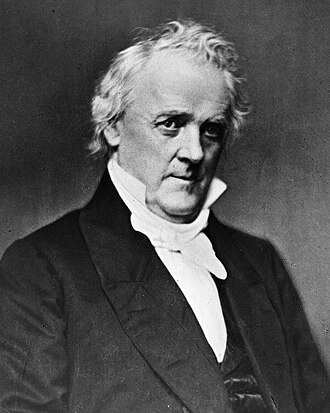
read to Congress. [1, pp. 128--29; 2, p. 252; 5, pp. 124--27; 8, p. 246; 7, pp. 61--62; 9, pp. 352--54; 11, p. 19; 14, p. 88; the portion of the message touching on secession may be found here.] |
|
||||||||
| Dec. 8, 1860 | Howell
Cobb, the pro-secession Secretary of the Treasury from Georgia, resigns
his position. [1, p. 159; 5, p. 130; 9, p. 359; 13, p. 535.] President Buchanan meets with some members of the South Carolina Congressional delegation, who give him a letter the next day. [1, p. 146; 5, pp. 132--34; 7, p. 85; 9, p. 357; 12, p. 116; full text of the letter may be found here.] President-elect Lincoln secretly offers the position of Secretary of State to William Seward, his chief rival for the Republican nomination. (For reasons that speak to the nature of mid-19th Century politics, the offer was not conveyed to Seward by the intermediaries tasked to do so until the 13th.) [5, p. 185; 7, p. 89; 14, pp. 161--63.] |
|
||||||||
| Dec. 10, 1860 |
North Carolina moderate Congressman
John Gilmer,
occasionally mentioned as a possible choice for Lincoln's Cabinet, writes a letter to the President-elect, posing six very
specific questions as to Lincoln's
policies, and asking Lincoln
to issue some kind of statement "to give the people of the United
States the views and opinions you now entertain on certain political
questions which now so seriously distract the country."
Lincoln replies, confidentially, on the 15th (see below). [1, pp. 167--68; 14, pp. 143--44; the text of Gilmer's letter can be found here; Lincoln's response (see below) is here.] Lincoln writes to U.S. Senator Lyman Trumbull regarding compromise on the issue of slavery in the territories. [Roy P. Basler, Collected Works of Abraham Lincoln, Volume 4, pp. 149--150; full text of the letter may be found here.] |
|
||||||||
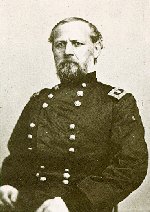
| Dec. 11, 1860 | Maj.
Don Carlos Buell arrives in Charleston with verbal orders for Anderson.
Buell makes a written memorandum of the verbal orders. [1, pp. 147--48; 4, pp. 50--52; 5, pp. 148--49, 152; 6, p. 10; 7, pp. 106--07; 12, pp. 89--90; 13, p. 539; a copy of the Memorandum may be found here.] The South Carolina Legislature elects Francis Pickens as Governor of the state. [1, p. 131; 2, pp. 79; 5, p. 142--47.] Similar to his letter of the previous day, Lincoln writes to Illinois Congressman William Kellogg regarding compromise on the issue of slavery in the territories. [Roy P. Basler, Collected Works of Abraham Lincoln, Volume 4, p. 150; full text of the letter may be found here.] |
|
||||||||
| Dec. 12, 1860 |
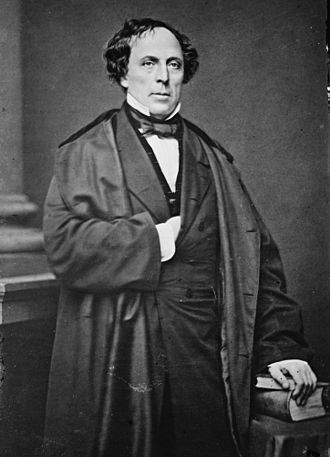
Secretary
of State Lewis Cass resigns his post because President Buchanan had
refused to reinforce the forts in Charleston Harbor.
[1, p. 159; 2, p. 44; 5, p. 134; 6, p. 10; 7, p. 86; 9, p. 358; 11, p. 26; 13, p. 518; 15, p. 536 (different date); full text of his resignation letter is here.] |
|
||||||||
| Dec. 14, 1860 | A
group of 30 Southern Senators and Representatives issue a "manifesto"
in favor of secession and the creation of a Southern Confederacy. [5, p. 134; 11, pp. 26--27; the full document may be found here.] Stephens responds to Lincoln's Nov. 30 request for his speech to the Georgia legislature, saying that he had not revised the speech, and so the newspaper accounts were essentially accurate. [14, p. 144; Basler, Collected Works of Abraham Lincoln, Vol. 4, p. 146.] |
|
||||||||
| Dec. 15, 1860 |
President-elect
Lincoln responds, confidentially, to Congressman Gilmer's letter of the
10th (see above).
[1, pp. 167--68; 14, pp. 143--44; the full text of Lincoln's reply may be found here.] |
|
||||||||
| Dec. 17, 1860 | Governor
Pickens requests permission of President
Buchanan to send a garrison of no more than 25 men to Fort
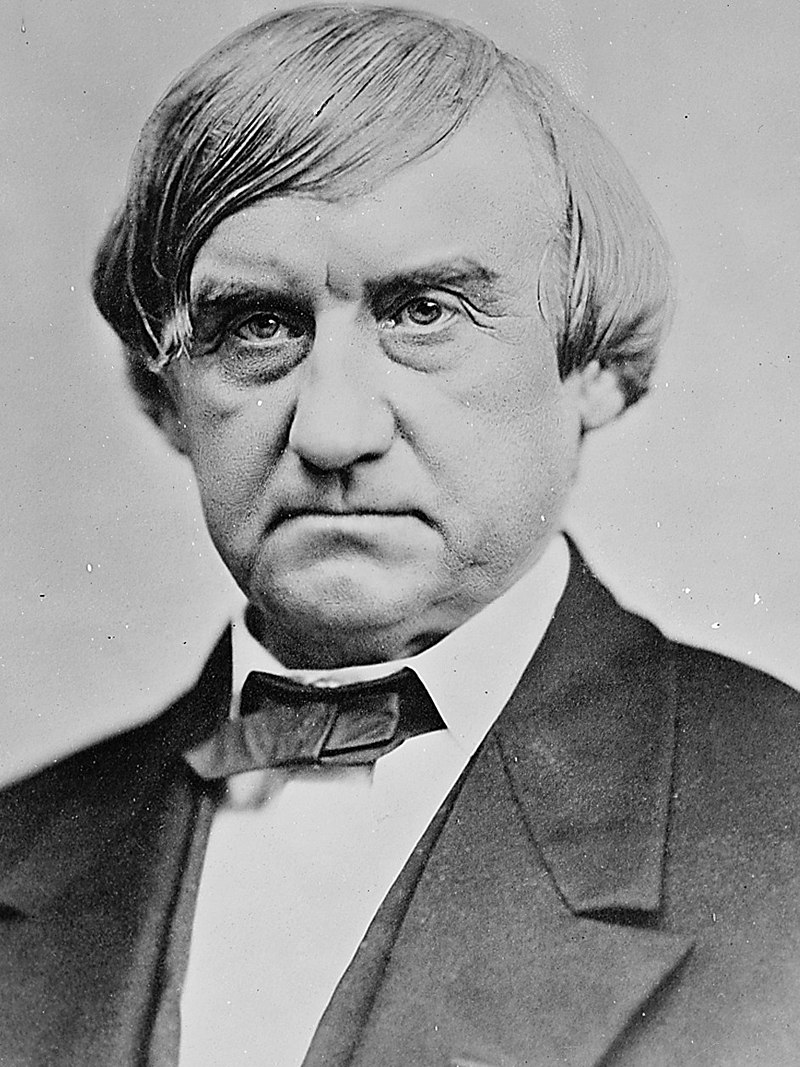
Sumter. [1, p. 151; 2, pp. 81--83; 5, p. 144; 9, pp. 365--66.] Attorney General Jeremiah Black is appointed Secretary of State by President Buchanan. [1, p. 159; 6, p. 11; 7, p. 86; 9, p. 358; 11, p. 26; 13, p. 518.] South Carolina Secession convention opens in a Baptist church in Columbia; a resolution affirming that the convention should pass an ordinance of secession is approved, but a smallpox outbreak in the city forces the Convention to adjourn to Charleston. [1, pp. 131--32; 4, p. 55; 5, p. 144; 6, p. 11; 11, p. 5.] Lt.
J.G. Foster, of the Federal garrison,
draws 40 muskets from the Federal arsenal in Charleston.
[1, p. 150; 2, pp. 76--77; 4, p. 36; 5, p. 153; 9, p. 366.] |
|
||||||||
| Dec. 19, 1860 |
Foster
is ordered by the Secretary of War,
John Floyd, to return the muskets, which he does.
[1, pp. 133, 150; 2, pp. 77--78; 4, p. 36; 9, p. 366.] |
|
||||||||
| Dec. 20, 1860 |
South Carolina
convention passes an ordinance of secession, by a vote of 169--0.
[1, p. 133; 2, pp. 88; 4, p. 55; 5, pp. 139, 145; 6, p. 12; 7, p. 105; 8, p. 235; 9, p. 359; 11, pp. 7, 27.] President Buchanan learns of South Carolina's secession at a wedding reception, when Congressman Lawrence Keitt of South Carolina bursts in screaming, "Thank God! Oh, Thank God!" [5, p. 139; 6, p. 12.] Secretary
of War Floyd orders 125 heavy
cannon
to be shipped from Pittsburgh to incomplete fortifications in the Deep
South (one at Galveston, Texas, a second on Ship Island in Mississippi
Sound). [1,
p. 175; 7,
p. 109; 8, p. 226; 9, p. 375.] |
|||||||||
| Dec. 21, 1860 |
President-elect
Lincoln writes to Lt. General Scott through Congressman Elihu Washburne
(concerning the coastal forts seized by the seceding states), saying,
"Please present my respects to the General, and tell him,
confidentially, I shall be obliged to him to be as well prepared as he
can to either hold, or retake, the forts, as the case may
require, at, and after the inaugeration."
[1, p. 170; 3, p. 17; 7, p. 88; 8, p. 249--50; full document is here.] The South Carolina Convention selects James
Orr, Robert Barnwell, and James Adams as "commissioners" to
the United States government.
[1, p. 157; 5, p. 147.] |
|
||||||||
| Dec. 22, 1860 |
President-elect
Lincoln writes a friendly letter to Georgia Congressman (soon to be
Confederate Vice President) Alexander Stephens, who replies later in the month.
(The two men had shared a boarding
house during Lincoln's one term in Congress.)
[1, pp. 113-14; 14, pp. 143--145; the full text of Lincoln's letter is here.] |
|||||||||
| Dec. 23, 1860 | Rumors of the
financial scandal involving Secretary
of War Floyd begin to emerge. [1, pp. 172--73; 5, pp. 149--51; 9, pp. 372--374; 11, pp. 31--32.] |
|||||||||
| Dec. 24, 1860 |
The South
Carolina commissioners depart for Washington.
[5, pp. 154, 162.] |
|||||||||
| Dec. 25, 1860 | Buchanan learns of Floyd's efforts to ship
cannon to southern forts, and countermands the orders. [5, p. 169; 8, p. 226; 9, p. 375.] |
|
||||||||
| Dec. 26, 1860 |
Maj.
Anderson moves his command from Fort
Moultrie to Fort Sumter. He is able to take with him "about four
months' supply of provisions for [his] command."
[1,
pp. 154--57; 4, pp. 59--67; 5, pp. 154--57; 6, pp. 15--16; 7, p. 107; 8, p. 265; 9, p. 367; 11, pp. 28--29; 12, p. 2; 13, p. 540; 14,
pp. 45, 253.]
Robert Barnwell Rhett proposes that representatives of the slave states should meet in Montgomery, Alabama, to form a new government. This passes the South Carolina Secession Convention on the 31st. [5, p. 240.] Assistant Secretary of State William Henry Trescot (of South Carolina) arranges lodgings for the Commissioners from South Carolina. Buchanan agrees to meet the "private gentlemen" the following afternoon. [5, p. 169.] |
|
||||||||
| Dec. 27, 1860 | Gov.
Pickens demands that Anderson return to Fort Moultrie; Anderson
refuses. South Carolina troops occupy Fort Moultrie and Castle Pinckney. [4, pp. 70--74, 79--80; 5, pp. 164--65; 7, p. 107; 9, pp. 368, 383.] |
|||||||||
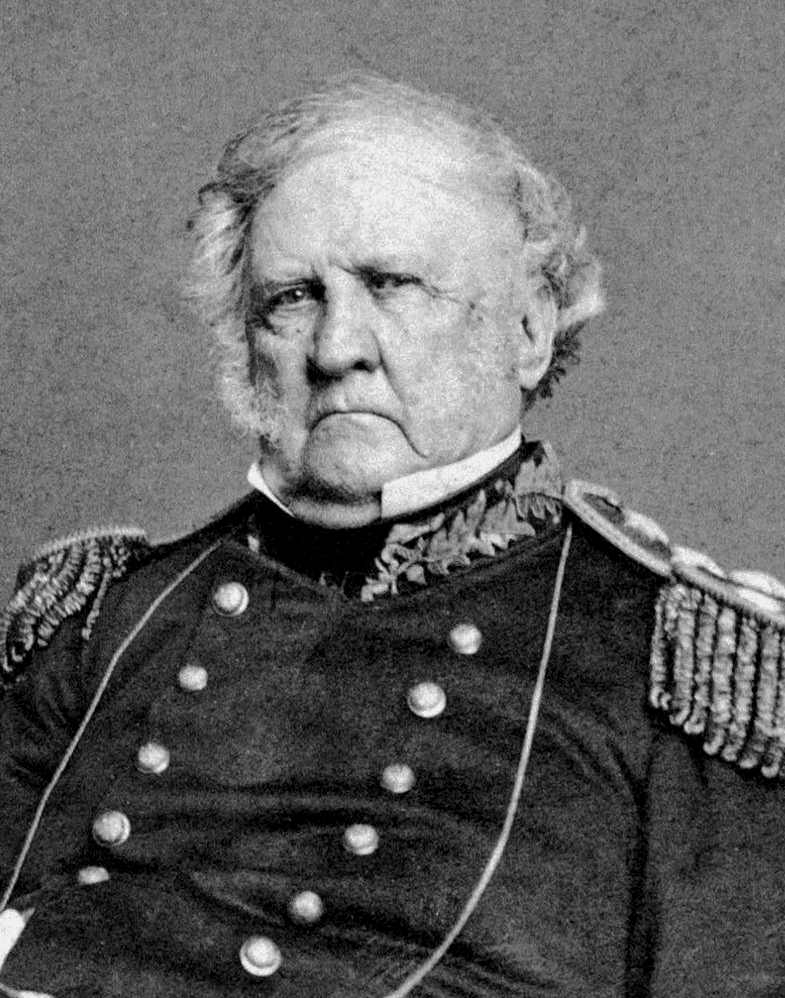
| Dec. 28, 1860 | Gen. Winfield Scott writes to Secretary of War Floyd, advocating the sending of reinforcements to Fort Sumter. [1, pp. 161--62; 12, p. 112; full document is here.] The South Carolina Commissioners meet with Buchanan and demand that Maj. Anderson return to Fort Moultrie. [5, p. 172; 7, pp. 112--13; 11, p. 30; 12, pp. 109--11; 13, p. 541; 14, pp. 254, 268; the document that the commissioners presented to President Buchanan may be found here.] Senator William H. Seward of New York, confidentially accepts President-elect Lincoln's appointment as Secretary of State. [2, p. 317; 14, p. 254.] |
|
||||||||
| Dec. 29, 1860 | Floyd resigns as Secretary of War. [1, pp. 172--73; 2, p. 149; 5, pp. 172--73; 6, pp. 16; 9, p. 375; 11, p. 32; 13, p. 542.] |
|
||||||||
| Dec. 30, 1860 | South Carolina seizes
the Charleston Arsenal.
Gen. Scott again writes to Buchanan, urging the reinforcement of Fort Sumter. [1, pp. 164--65; 5, p. 174; 6, p. 17; 9, p. 377; 12, p. 114, full text is here.] Alexander Stephens replies to President-elect Lincoln's letter of the 22nd. [1, pp. 113-14; 14, pp. 143--45; the full text of Stephens's letter is here.] |
|||||||||
| Dec. 31, 1860 | Postmaster-General Joseph Holt named Secretary
of War, replacing Floyd. [1, p. 174; 2, p. 150; 5, pp. 176; 7, p. 113; 9, p. 382; 11, p. 33; 13, p. 543] President Buchanan replies to the demands of the South Carolina commissioners; he refuses to order Maj. Anderson back to Fort Moultrie, and instead issues orders (later) to send reinforcements and provisions to him at Fort Sumter. [1,
p. 174; 2, pp. 156--58; 5, pp. 175--77; 6,
pp. 17--18; 7, p. 113;
9, pp. 376--79; 11, p. 33; 13, p. 542; 14, p. 254; the full text of
Buchanan's document may be found here.] |
|
||||||||
| Jan. 2, 1861 |
South
Carolina seizes Fort Johnson, in
Charleston Harbor.
[2, p. 123; 5, p. 165; 6, p. 21.] The South
Carolina commissioners present their reply to Buchanan's note of the 31st.
Buchanan finds it "of such a character that he declines to receive
it." The commissioners
leave Washington before that reply reaches their hotel.
[1, p. 174; 5, p. 191; 12, pp. 120--25; full document is here.] |
|||||||||
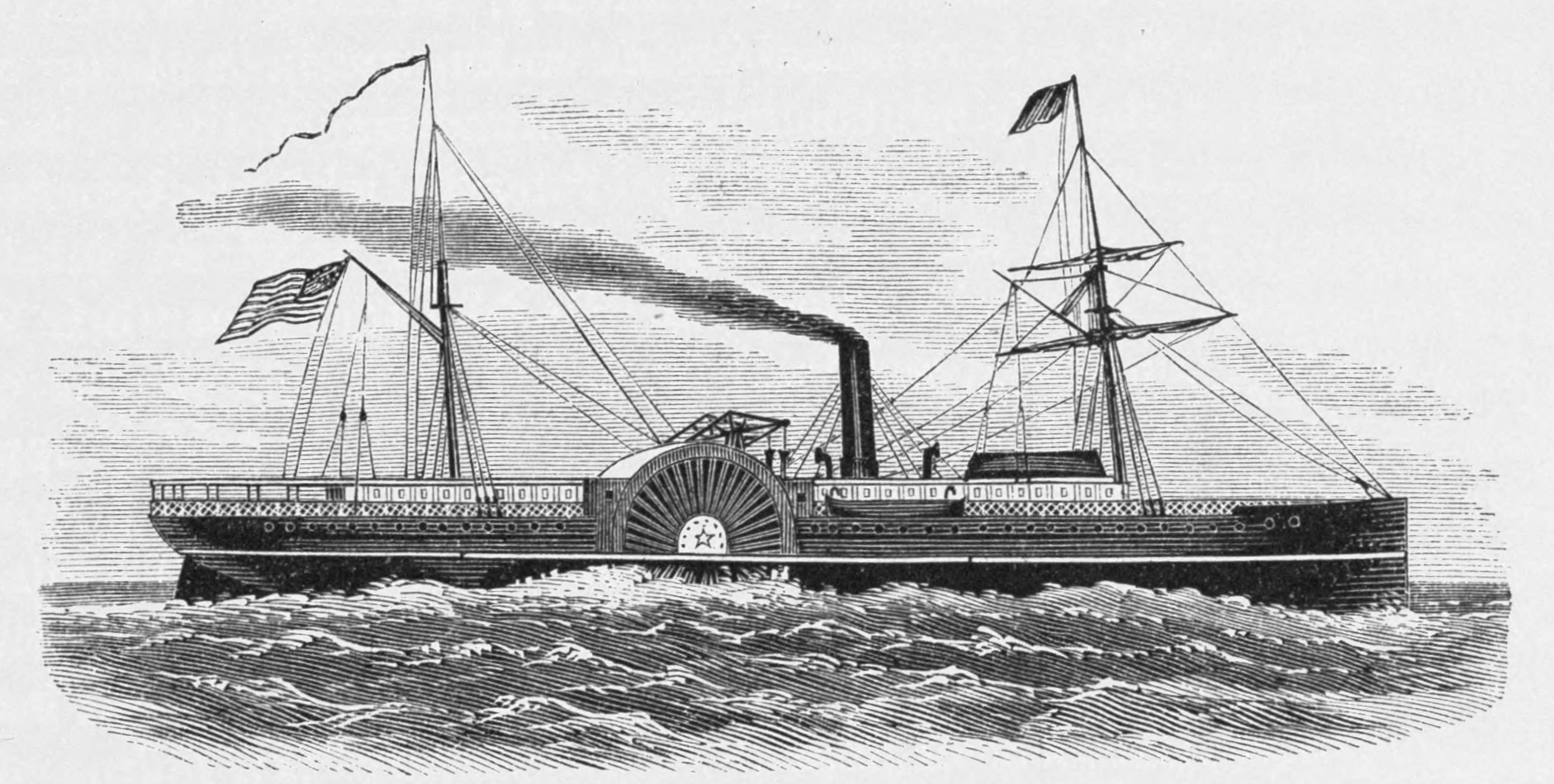
| Jan. 5, 1861 | The Star of the West
sails from New York with 250 recruits and supplies for Fort Sumter on
board. [1, pp. 177--181; 2, p. 176; 5, pp. 191--92; 6, p. 22; 7, pp. 119--20; 8, p. 266; 9, pp. 379--80; 11, p. 33; 12, p. 128; 13, p. 542.] |
|
||||||||
| Jan. 7, 1861 | The
House of Representatives passes a
resolution supporting Maj. Anderson's shift from Fort Moultrie to Fort
Sumter. The resolution was offered by Congressman Garnett Adrain
of New Jersey, a Democrat, and the text is here. The vote was 124
in favor, 56 opposed. [6, p. 22; Congressional Globe, 36th Congress, 2nd Session, Part 1, pp. 280--82; a PDF of the relevant pages is here.] Virginia's Gov. John Letcher addresses his state legislature, proposing a national convention (which would become the Washington Peace Convention) but also opposing any Federal efforts to coerce the seceding states into returning to the Union. In response, the legislature endorsed his plea for a national convention, proposing a date of Feb. 4; it also called for elections to a state convention to consider secession, to meet on Feb. 13; finally, the legislature adopted the following resolution: "That if all efforts to reconcile the unhappy differences existing between the two sections of the country shall prove to be abortive, then, in the opinion of the General Assembly, every consideration of honor and interest demands that Virginia shall unite her destiny with the slave-holding States of the South." [1, p. 196; relevant partial text of Letcher's message is here, and the full legislative resolution is here; Official Records of the War of the Rebellion, Ser. IV, vol. 1, p. 77.] |
|
||||||||
| Jan. 8, 1861 | Secretary of the Interior Jacob Thompson, the
last Southerner in Buchanan's Cabinet, resigns, but not before he telegraphs South
Carolina officials about the mission of the Star of the West. (Senator Wigfall, of Texas,
also sent a warning telegram.) [1, pp. 179; 2, pp. 179--181; 5, p. 208; 6, p. 23; 11, p. 33; 12, p. 253; 13, pp. 542--43.] |
|
||||||||
| Jan. 9, 1861 |
The Star of the West, flying
a United States flag,
is
fired upon as it enters Charleston Harbor, and is driven off. Anderson and Pickens exchange angry letters over the incident. Anderson then proposes that Lt.
Theodore Talbot should be sent to Washington to seek further
instructions from the Goverment. Pickens agrees, and Talbot catches a train north.
[1,
pp. 180--82;
2,
pp. 183--186; 4, pp. 102--06; 5, pp. 195--201; 6, p. 23; 7, pp. 119--20; 8, p. 266; 9, p. 380; 11, p. 34; 12, pp. 134--36, full text of the
complete correspondence is here; 13, pp. 542--43.]
|
|
||||||||
| Jan. 10, 1861 |
Florida
secedes.
[1, pp. 184, 187; 5, p. 203; 6, p. 24; 9, p. 417.] Lt. Adam Slemmer, fearing attack by local militia, transfers his garrison of 51 soldiers and 30 sailors from Fort Barancas (on the Florida mainland) to Fort Pickens (on Santa Rosa Island), across Pensacola Bay. [1, p. 274; 3, p. 47; 5, pp. 205--06; 6, p. 24; 11, p. 38; 12, p. 334.] Holt
writes to Anderson, mostly to "to express the great satisfaction of the
Government at the forbearance, discretion, and firmness with which you
have acted, amid the perplexing and difficult circumstances in which
you have been placed to
express the great satisfaction of the Government at the forbearance,
discretion, and firmness with which you have acted, amid the perplexing
and difficult circumstances in which you have been placed."
[5, p. 208; 12, p. 136--37, full document is here.] |
|
||||||||
| Jan. 11, 1861 |
Gov.
Pickens orders hulks sunk in the ship channels to make it more
difficult
for vessels to enter the harbor. He then sends two emissaries to
Fort Sumter to demand its surrender, which is refused by Anderson. After some discussion
between Anderson and the emissaries, Maj.
Anderson proposes that both
sides send "messengers" to
Washington.
[1, pp. 183--84; 2, pp. 192--194; 5, pp. 201--202; 6, p. 25; 11, pp. 34--35; 12, pp. 137--38; full text of the two letters is here.] The New York legislature passes resolutions in support of the President. [1, p. 201; full text of the resolutions is here.] |
|||||||||
| Jan. 12, 1861 | A
boat flying a white flag approaches Fort Sumter, carrying Gov.
Pickens's affirmative response to Anderson's
proposal of the previous day.
Attorney-General Isaac
W.
Hayne, who carries a letter to President Buchanan demanding that Fort
Sumter be turned over to the State, is selected to represent South
Carolina to the United States, and
Lt. Norman Hall of the garrison joins him to communicate with the
United States Government. [1, pp. 186--87; 2, pp. 195--197; 5, p. 202; 6, p. 26; 7, pp. 134--35; 11, p. 35; 13, pp. 543-44.] Florida state troops occupy Forts Barancas and McRee, and the Pensacola Navy Yard. They also demand the surrender of Fort Pickens. [1, p. 274; 5, pp. 206--07; 6, p. 25; 12, pp. 335--39.] Sen. William H. Seward of New York, Secretary of State-designate in Lincoln's Cabinet, delivers a speech in the Senate in favor of much compromise. [5, pp. 226--227; 6, p. 26; 7, pp. 121--22; 9, p. 399 (typoed date); 14, pp. 285--87; Congressional Globe, 36th Congress, 2nd Session, Part 1, pp. 341--343.] The State of Ohio passes legislative resolutions in support of the General Government, but opposed to "meddling" in the internal affairs of other States. [Full text of Resolutions is here.] |
|
||||||||
| Jan. 13, 1861 |
Mississippi's Sen. Jefferson Davis writes
to Gov. Pickens. Hayne and Hall reach Washington.
[2, pp. 263--65; 5, pp. 204--05, 208; full text of the letter is here; 6, p. 26.] |
|
||||||||
| Jan. 14, 1861 |
Virginia's
legislature calls for a
secession convention, with the delegates to be elected on Feb. 4th.
[13, p. 505; 14, p. 306.] Hayne has an "informal" and
unofficial" interview with
President Buchanan.
[2, pp. 218; 5, p. 208.] |
|||||||||
| Jan. 15, 1861 | Florida
again demands the surrender of Fort Pickens, and is again refused. [5, p. 207; 6, p. 27; 12, pp. 337--38, documents are here.] Ten
Senators from Deep South States intervene with Hayne to temporarily
withhold his letter demanding the surrender of Fort Sumter.
[11, pp. 35--37; 13, pp. 543--44; full text of the letter is here.] The Arkansas Legislature votes to hold elections (on Feb. 18) on whether to hold a secession convention, and also for the delegates to the convention. [Edward McPherson, Political History of the United States During the Great Rebellion, 1864, p. 4; Journal of Both Sessions of the Convention of the State of Arkansas, p. 3; text of legislation is here.] |
|||||||||
| Jan. 16, 1861 |
Secretary
of State Jeremiah Black writes to Lt. Gen. Scott, inquiring about the
possibility of re-inforcing Fort Sumter.
[2, pp. 237--39; 12, pp. 140--42; full text of the letter is here.] Secretary
of War Holt writes to Maj. Anderson, approving his forbearance in not
firing upon the South Carolinians when they fired upon the Star of the West;
the letter closes with the following: "Whenever, in your judgment,
additional supplies or re-enforcements are necessary for your safety,
or for a successful defense of the fort, you will at once communicate
the fact to this Department, and a prompt and vigorous effort will be
made to forward them."
[12, p. 140; full text is here.] |
|
||||||||
| Jan. 18, 1861 | Lt. Slemmer again refuses to surrender Fort
Pickens. [5, p. 207; 6, p. 27; 12, p. 339, document is here.] |
|||||||||
| Jan. 19, 1861 | Virginia invites states to a convention in
Washington, on Feb. 4, to
propose compromise
measures aimed at solving the crisis. This leads to the so-called
Washington Peace Conference. [1, p. 237; 6, p. 28; 9, p. 411; 13, p. 546.] South Carolina sends 48 hours
worth of food supplies to Fort Sumter; this is the first such shipment
of
supplies since the garrison moved from Fort Moultrie, but Anderson refuses to accept them.
[2, pp. 201--02; 12, pp. 143--46, full documentation is given in the January 21 entry.] |
|||||||||
| Jan. 20, 1861 |
Florida's Senators (Stephen R. Mallory and
David L. Yulee) advise Florida Governor M.F. Perry not to attack Fort
Pickens, saying, "[T]he fort is not worth one drop of blood at this
time." This follows similar advice given the two previous days by
most of the Southern Senators to Gov. Perry and Alabama Gov. A.D. Moore.
[5, pp. 210--11; 12, p. 445; full documentation is here.] |
|||||||||
| Jan. 21, 1861 |
Maj.
Anderson writes to the Secretary of War upon the subject of provisions
being offered by South Carolina, and his decision to decline them.
[4, pp. 113--14; 12, pp. 143--44; full documentation is here.] The Virginia legislature passes the following resolution: Resolved
by the General Assembly of Virginia: That if all efforts to reconcile
the unhappy differences existing between the two sections of the
country shall prove to be abortive, then, in the opinion of the General
Assembly, every consideration of honor and interest demands that
Virginia shall unite her destiny with the slave-holding States of the
South.
[Official Records, Series IV, Vol. 1, p. 77; see also here.] Five Southern Senators, including future Confederate President Jefferson Davis, announce their resignations from the Senate. [1, pp. 190--92; 5, p. 228; 6, p. 28; 9, pp. 447--48; many of the "farewell speeches" may be found here.]
Senator Seward introduces a bill to admit Kansas as a free state; the bill passes, 36--16. [1, p. 192; 5, p. 228; 9, pp. 448; the relevant pages from the Congressional Globe (PDF format) are here.] |
|
||||||||
| Jan. 22, 1861 |
President Buchanan informs (through
Secretary of War Holt) a group of Senators from now-seceded states,
that he intends to hold Fort Sumter.
[2, p. 240; 12, pp. 149--50; full text of the letter is here.] P.G.T. Beauregard assumes the position of Superintendant of West Point. [15, p. 45.] The State of Minnesota passes legislative resolutions in support of the incoming administration, declaring that secession amounts "directly to revolution." [Full text of Resolutions is here.] |
|||||||||
| Jan. 24, 1861 | Federal
reinforcements set sail for Fort Pickens on board the U.S.S. Brooklyn. [6, p. 29; 12, pp. 352--53, full documentation is here.] The
State of Pennsylvania passes legislative resolutions declaring that
secession of a single state "is utterly repugnant," and "That all
plots, conspiracies and warlike demonstrations against the United
States, in any section of the country, are treasonable in their
character, and whatever power of the government is necessary to their
suppression, should be applied to that purpose without hesitation or
delay."
[Full text of Resolutions is here.] |
|
||||||||
| Jan. 27, 1861 |
Anderson reports more to Washington regarding the state of his provisions.
[5, p. 247; 12, pp. 153--54; full document is here.] |
|||||||||
| Jan. 28, 1861 |
Beauregard relieved as Superintendant at West Point. [2, p. 276; 15, p. 46.] |
|||||||||
| Jan. 29, 1861 |
Congressman
Thaddeus Stevens, an extreme abolitionist Republican from Pennsyvania,
delivers a speech on the House floor in opposition to any
compromise. In his view, the Union is perpetual, and worth
fighting for. [Congressional Globe, 36th Congress, 2nd Session, pp. 621--624.]
An informal truce is reached at Fort Pickens: The state troops will not attack, communications through Pensacola will be kept open, and the reinforcements on the Brooklyn may not be landed (unless the state troops attack, or appear to be getting ready to do so. |
|||||||||
| Jan. 30, 1861 | President-elect
Lincoln travels to visit his aging step-mother, Sally, in Farmington,
near Charleston, Illinois. According to some accounts, she
predicts that he would be killed in Washington. [5, p. 257.] |
|
||||||||
| Jan. 31, 1861 | Hayne formally demands the surrender of
Fort Sumter, in a written letter to President Buchanan. [1, p. 186; 2, p. 226, full text of the letter is here; 5, p. 230; 7, p. 135; 13, p. 544.] |
|
||||||||
| Feb. 1, 1861 | Forty-two women and children are
permitted to leave Fort Sumter on a steamer for New York. [2, pp. 206--207; 4, p. 117; 5, p. 247.] |
|||||||||
| Feb. 2, 1861 |
The Legislature of the State of Michigan passes resolutions in opposition to secession.
|
|||||||||
| Feb. 4, 1861 | Washington Peace Conference opens. [1, p. 237; 2, p. 256; 4, p. 119; 5, p. 238; 6, p. 32; 7, p. 180; 8, pp. 256--57; 9, p. 445; 11, p. 39; 13, pp. 545--47.] Virginia elects delegates to a state convention to consider secession. [1, pp. 196--97; 7, p. 168; 14, p. 306.]
Representatives of six of the seven
seceded states meet in a convention in Montgomery, Alabama, to
form a new government. (The Texas delegation has not yet arrived.) [1, p. 204; 5, pp. 242; 11, pp. 37, 39; 13, p. 545.]
|
|||||||||
| Feb. 5, 1861 |
Maj.
Anderson reports that the engineering works being mounted against his
small force are "well devised and well executed, and their works, even
in their present condition, will make it impossible for any hostile
force, other than a large and well-appointed one, to enter this harbor."
[2, pp. 289--90; 12, p. 163; full document is here.] |
|
||||||||
| Feb.
6, 1861 |
Secretary
of War Holt informs Hayne that under
no circumstances will Fort Sumter be surrendered.
[1, p. 186; 2, pp. 228--231; 5, p. 236; 11, p. 37; 12, pp. 166--168; 13, p. 544; full document is here.] The
U.S.S. Brooklyn arrives at Fort Pickens carrying reinforcements;
however, due to the informal truce in effect (see above, Jan. 29), they
are not landed.
[2, p. 401; 12, pp. 357--58.] |
|
||||||||
| Feb. 7, 1861 | President
Buchanan is briefed by Secretary of War Holt on the plan developed by
Gustavus Fox to resupply Fort Sumter using small boats at night. [1, p. 272; 5, p. 283.] Captain Vogdes informs Washington why he was unable to land his troops into Fort Pickens. [12, pp. 357--58; documents in full are here.] |
|
||||||||
| Feb. 8, 1861 | The
provisional Constitution of the Confederate States of America is
approved in Montgomery, Alabama. The next day, Jefferson Davis is
elected as provisional President, and Alexander Stephens as provisional
Vice-President. [1, pp. 209--212; 4, p. 120; 6, p. 32; 8, p. 259; 11, p. 41; 13, p. 547.] |
|
||||||||
| Feb. 9, 1861 | Tennessee rejects a call for a secession
convention by a vote of 68,000 to 59,500. [5, p. 274; 6,
p. 34; Edward McPherson, The Political History of the United States of America During the Great Rebellion, 1864, p. 5 (slightly different vote tally).]
The Confederate
Government urges South Carolina not to attack Fort Sumter "without the
sanction and jurisdiction of our joint Government." |
|||||||||
| Feb. 11, 1861 | Lincoln leaves Springfield, Illinois, for
Washington, D.C. He
stops overnight in Indianapolis where he speaks to a crowd outside his
hotel. (He also spoke to crowds at nearly every stop along the
way.) [1, p. 216; 5, pp. 261--62; 6, p. 35; 7, p. 181; 11, p. 45; 13, pp. 560--61; 14, pp. 316--18.] Anderson reports that new British cannon received by South Carolina are a serious threat to the security of his position. [5, p. 283; 12, p. 169.] |
|||||||||
| Feb. 12, 1861 | Lincoln travels to Cincinnati, where he again
speaks to a crowd at his hotel. [5, p. 263; 6, p. 36; 14, pp. 316--18.] The Confederate
Congress passes a resolution to take charge of the issues between the
CSA and United
States over the occupied forts.
[1, p. 249; 2, p. 261; 12, p. 254; full text of the resolution is here.] |
|||||||||
| Feb. 13, 1861 |
Lincoln's
train now takes him to Columbus, where he
addresses the state legislature. The Electoral Votes are
officially counted,
certifying Lincoln's election as President.
[1, p. 220; 5, pp. 263--64; 6, p. 36; 7, p. 182; 11, p. 49; 13, p. 561; 14, pp. 316--18.] Virginia secession convention opens. [6, pp. 36--37; Freehling, Showdown in Virginia, p. xxiv.]
Gov. Pickens sends a letter to the Confederate Congress, demanding that "Fort Sumter should be reduced before the close of the present administration." [12,
pp. 254--57; full text of the letter is here.] |
|||||||||
| Feb. 14, 1861 | Lincoln leaves Columbus for Pittsburgh; after
giving a speech he leaves for Cleveland. [5, p. 264; 6, p. 37; 7, p. 182; 14, pp. 316--18.] |
|||||||||
| Feb. 15, 1861 | The
Provisional Confederate Congress authorizes Davis to take "immediate
steps" to acquire Forts Pickens and Sumter, via negotiation or force. [3, p. 139; 5, p. 295; 12, p. 258; full text here.] The Provisional Confederate Congress adopts a resolution calling for the appointment of "commissioners" to negotiate with the United States Government. [Richardson, James D., Messages and Papers of the Confederacy, Vol. I, United States Publishing Company, Nashville, 1905 (Archive Society 1996 reprint), p. 55; full text of the resolution is here.] |
|||||||||
| Feb. 16, 1861 |
Lincoln
leaves Cleveland for Buffalo, New York. Upon reaching the small
town of Westfield, New York, he asks to see the young girl who had
written to him and suggested he grow a beard.
[5, pp. 264--265; 6, p. 38; 14, pp. 316--18.] Jefferson Davis arrives in Montgomery. [1,p. 214; 5, p. 254.] |
|
||||||||
| Feb. 17, 1861 | Lincoln
attends church with former President Millard Fillmore, a resident of
Buffalo. [5, pp. 265--66; 14, pp. 316--18.] |
|||||||||
| Feb. 18, 1861 |
Jefferson Davis is
inaugurated as Provisional President of the Confederate States of
America.
[1, p. 254; 5, p. 255; 11, p. 42; full text of his inaugural speech may be found here.] Lincoln leaves Buffalo for Albany and a speech before the New York legislature. [1, p. 220; 5, p. 266; 6, p. 39; 14, pp. 316--18.]
Brevet Brig. Gen. David Twiggs of the U.S. Regular Army surrenders the posts in the Department of Texas to state authorities. [1, pp. 226--30; 5, p. 234; 6, p. 39; 10, p. 18; 11, p.14; 12, pp. 503--511.]
Arkansas votes to call a secession convention, but the elections for delegates leave it dominated by Unionists. [5, p. 274; Edward McPherson, The Political History of the United States of America During the Great Rebellion, 1864, p. 4.] |
|
||||||||
| Feb. 19, 1861 | Lincoln leaves Albany for New York City. [5, p. 266; 6, p. 39; 14, pp. 316--18.] Alarmed by rumors that Gov. Pickens plans to attack Fort Sumter soon, Buchanan and his
Cabinet hastily organize a relief expedition but do not implement the plan, largely because former President John Tyler, soon to be a Confederate Congressman, assures them that no attack is planned.
[5, p. 283.] |
|||||||||
| Feb. 20, 1861 | In a meeting with Mayor Fernando Wood of New
York, Lincoln says, "There
is nothing that can ever bring me willingly to consent to the
destruction of this Union." [1, pp. 220--21; 6, p. 40; 14, pp. 316--18.] Major P.G.T. Beauregard resigns his commission in the United States Army. [15, p. 46.] |
|||||||||
| Feb. 21, 1861 |
The
Lincoln party leaves New York for
Philadelphia. That evening he is first informed of the
possibility of plots against his life, to be carried out in Baltimore.
[3, p. 23; 5, pp. 267--69; 6, p. 40; 14, pp. 256--57, 316--18.] |
|
||||||||
| Feb. 22, 1861 | President-elect Lincoln addresses a
Washington's Birthday
celebration at Independence Hall in Philadelphia,
saying, in part, "It shall be my endeavor, to preserve the peace of
this country so far as it can be done, consistently with the
maintenance of the institutions of the country," then leaves for
Harrisburg, where he addresses the state legislature. [1, pp. 222--225; 3, p. 19; 5, p. 270; 6, pp. 40--41; 13, p. 561; 14, pp. 256--57, 316--18.] Confederate guns in Castle Pinckney fire a salute in honor of Washington's Birthday; Fort Sumter's guns respond in kind. [5, p. 297.] |
|||||||||
| Feb. 23, 1861 |
After
an all-night train ride (Harrisburg to Philadelphia to Baltimore to
Washington, planned so that Lincoln's car passes through Baltimore in
the dead of night) in secret,
Lincoln arrives in Washington at 6 a.m.
That evening, after
dinner, President Lincoln meets with former President John Tyler of
Virginia, leader of the Washington Peace Conference and a delegation of
members of that conference.
[1, p. 236; 3, pp. 15--17, 29; 5, pp.
270--71,
276--77; 6,
p. 41; 8, pp. 261--62; 13, p. 562; pp. 256--57, 316--18.]
The Confederate government sends Maj. W.H.C. Whiting to Charleston to assess the situation. [1, p. 250; 5, p. 295; 12, p. 258, full document is here.] |
|
||||||||
| Feb.
27, 1861 |
Lincoln
meets with a delegation of Virginians from the Peace Conference,
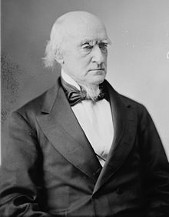
including the aged William C.
Rives. According to some accounts, after much discussion, Lincoln
tells Rives that he would withdraw the troops from Fort Sumter if
Virginia would not secede. [1, p. 298; 3, p. 34; 5, p. 279; 7, pp. 196--97; 14, pp. 353--54.] Final day of the Washington Peace Conference. [5, p. 285; 6, p. 42.]
Martin
J. Crawford, A.B. Roman, and John Forsyth, appointed (on Feb. 25) as
"commissioners" from the Confederate government to the United States
Government, for the settlement of "all questions of disagreement
between the two Governments," pursuant to the Resolution of the
Provisional Confederate Congress passed on Feb. 15, are this day handed
their formal instructions, in the form of a letter from President
Jefferson Davis to the President of the United States. |
|
||||||||
| Feb. 28, 1861 |
North Carolina rejects a call for a secession
convention.
[6,
p. 43; Edward McPherson, The Political History of the United States of America During the Great Rebellion, 1864, p. 5.]
The
Confederate Congress authorizes the raising of an army of indeterminate
size.
[1, p. 258; 2, p. 261; Statutes at Large of the Provisional Government of the C.S.A., p. 43.] |
|||||||||
| March 1, 1861 |
Davis
assigns Brig. Gen. P.G.T. Beauregard to the command of C.S. forces in
Charleston Harbor.
[1, pp. 251--52; 2, pp. 277--78; 6, p. 43; 8, p. 267; 11, p. 56; 12, pp. 259--60.] Confederate Secretary of War tells Gov. Pickens, "This Government assumes the control of military operations at Charleston, and will make demand of the fort when fully advised. An officer goes to-night to take charge." [12, p. 259.] |
|
||||||||
| March 2, 1861 | Lincoln,
at a dinner party, tells a German diplomat about his conversation with
Rives, saying that, "A State for a fort is no bad business." [3, p. 35.] Gov. Henry M. Rector of Arkansas calls the convention approved on Feb. 18 into session, beginning on March 4th. [Journal of Both Sessions of the Convention of the State of Arkansas, p. 5; text of the proclamation is here. |
|
||||||||
| March 3, 1861 |
Beauregard arrives in
Charleston. [1,
p. 252; 5, p. 335; 6,
p. 44; 15, p. 51.] Gen. Winfield Scott writes to Secretary of State (designate) William Seward advising a very conciliatory policy, embracing either the Crittenden proposal or those of the Peace Convention. [6, p. 44; 14, p. 264; the text of the letter is here; some authors believe that Seward actually wrote the letter himself.] Martin J. Crawford of Georgia, one of the Confederate Commissioners, arrives in Washington. [2, p. 316; 7, p. 207.] |
|
||||||||
| March 4, 1861 |
Abraham
Lincoln sworn in as the 16th President of the United States; in his
inauguration speech, he pledges "to hold, occupy, and possess the property
and places belonging to the government, and to collect the duties and
imposts."
[1, pp. 258--66; 2, p. 320; 3, pp. 36--42; 4, p. 128; 5, pp. 313--18; 6, p. 45; 7, pp. 187--94, 199-200; 8, pp. 261--63; 11, pp. 49--51; 13, p. 566--69; 14, pp. 319--29.]
Secretary of War Holt receives word from Maj. Anderson that, without 20,000 men in reinforcements, he cannot hold Fort Sumter; additionally, his supplies will not allow him to hold out for much longer than six weeks. This note is communicated to President Lincoln on March 5th. [1,
p. 261; 3,
p. 44; 5, pp. 312, 319; 6,
p. 45; 7, pp. 200--02; 8, p. 264; 11, p. 50; 13, p. 570; the full
set of documents may
be found here.]
Gov. Pickens of South Carolina telegraphs the Tredegar Iron Works in Richmond, Virginia: "Please send 400 shells for Dahlgren guns in addition to those already ordered." [4, p. 109; 10, p. 41.]
|
|
||||||||
| March 5, 1861 |
President
Lincoln asks Lt. Gen. Scott to offer his opinion on the several notes
received the day before from Maj. Anderson. Scott replies, "The
difficulty of reinforcing has now been increased 10 or 15 fold."
[1, p. 3, pp. 45--48; 5, p. 319; 8, pp. 267--68; 11, p. 50; 13, p. 571.] The
Richmond Enquirer calls Lincoln's Inaugural Address
a "Declaration of War."
[3, p. 52; full text of the editorial may be found here.] John Forsyth of Alabama, the second Confederate Commissioner, arrives in Washington. [7, p. 207.] |
|
||||||||
| March 6, 1861 | President
Lincoln holds his first, brief---mostly a formality---Cabinet meeting. [3, pp. 48--49; 7, p. 209.] The Confederate Government provides for the establishment of an army of up to 100,000 men. Beauregard assumes command at Charleston. [1, p. 258; 2, p. 306; 15, p. 53; Statutes at Large of the Provisional Government of the C.S.A., pp. 43--44.] |
|||||||||
| March 7, 1861 | Col.
Samuel Cooper, Adjutant-General of the United States Army, resigns his commission to take up
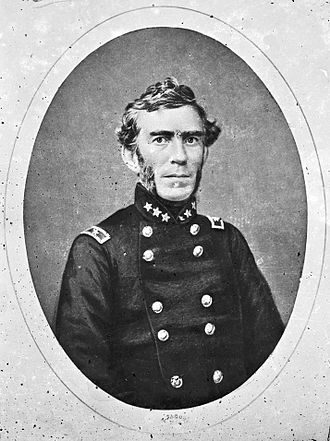
the same position within the Confederate Army. He is replaced by Col. Lorenzo Thomas. [2, p. 310; 4, pp. 128--29; 5, p. 326.] Brig. Gen. Braxton Bragg is assigned to the command of the Confederate troops "at and near Pensacola, Fla." [12, p. 448.] |
|
||||||||
| March 8, 1861 |
The
Confederate Commissioners, using California Sen. William Gwin as an
intermediary, send a memo to Secretary of State Seward, proposing to
delay action against Fort Sumter for 20 days in return for a promise
that the existing military position would be preserved.
[5,
p. 328; 6,
p. 48; 7, pp. 207--08; 14, p. 343.] |
|||||||||
| March 9, 1861 |
First
full meeting of Lincoln's Cabinet. President
Lincoln inquires of General Scott, "what amount of means, and what
description, in addition to those already at command, it would require
to supply and reinforce the fort." The consensus of the Cabinet is that the fort
should be
evacuated.
[1, p. 277; 2, pp. 346--347; 3, pp. 49--50; 5, p. 326; 6, p. 48; 7, pp. 202--03; Lincoln's query to Lt. Gen. Scott is here; 14, p. 337.] |
|
||||||||
| March 10, 1861 |
Seward meets with Virginia Senator R.M.T.
Hunter, now acting as intermediary for the Confederate commissioners.
Hunter asks that Seward meet, informally, with the commissioners
[1, p. 292; 5, p. 329; 7, pp. 208--09; 14, p. 344.] |
|||||||||
| March 11, 1861 |
Seward declines to informally meet
with the Confederate commissioners, so they present a
request for a
formal meeting.
[1, p. 292; 3, pp. 50;--51 6, pp. 48--49; 7, pp. 208--09; 14, p. 344.]
Confederate Brig. Gen. Braxton Bragg assumes command of the troops confronting Fort Pickens: PENSACOLA, FLA.,
March 11, 1861.
I. In compliance with Special Orders No. 1 from the War Department, Confederate States of America, dated at Montgomery, Ala., March 7, 1861, Brigadier-General Bragg assumes the command of all troops in the service of said States in the vicinity of Pensacola. His headquarters will be at Fort Barrancas. BRAXTON BRAGG, Brigadier-General, Commanding.
Lincoln orders Scott to reinforce the meagre garrison at Fort Pickens. [5, p. 360; 8, p. 268; 14, p. 359; see below (3/12/61) for full documentation.]
Former Texas Senator Louis Wigfall (who is still in Washington) sends the following telegrams:
WASHINGTON, March 11, 1861. General BEAUREGARD, Believed here that Anderson will be ordered to evacuate
Sumter in five days. Was certainly informally agreed on in Cabinet Saturday
night. May have been done as ruse to throw you off your guard and enable them
to re-enforce. LOUIS T. WIGFALL. ----- WASHINGTON, March 11, 1861. His Excellency
JEFFERSON DAVIS, It is believed here in Black Republican circles that
Anderson will be ordered to vacate Fort Sumter in five days. An informal
conclusion to this effect was arrived at Saturday night in Cabinet. Anderson
telegraphed, it is said, that he had no fuel and but fifteen days' provisions. LOUIS T. WIGFALL. [5, p. 334; 12, p. 273.] |
|
||||||||
| March 12, 1861 |
General
Scott replies to Lincoln (see March 9), saying that Anderson had hard
bread, rice,
and flour for only 26 days, and salt meat for 48; and to relieve the
fort it would take a force of 25,000 men, adding, "As a practical
military question the time for succoring Fort Sumter with any means at
hand had passed away nearly a month ago. Since then a surrender under
assault or from starvation has been merely a question of time."
[1, p. 277; 3, pp. 50--51; 5, p. 327; 6, pp. 48--49; 7, pp. 208--09; Scott's full document, taken from the Lincoln Papers at the Library of Congress, is here. 14, p. 337.] Scott, at Lincoln's direction, sends the U.S.S. Mohawk to Fort Pickens with the following orders (to Capt. Israel Vogdes, in command of the reinforcements onboard the Brooklyn): HEADQUARTERS OF THE ARMY,
Washington, March 12, 1861.
Captain VOGDES, U. S. Army, On board U. S. sloop-of-war Brooklyn, lying off Fort Pickens: SIR: At the first favorable moment you will land with your company, re-enforce Fort Pickens, and hold the same till further orders. Report frequently, if opportunities present themselves, on the condition of the fort and the circumstances around you. I write by command of Lieutenant-General Scott. I am, sir, very respectfully, your obedient servant, E. D. TOWNSEND, Assistant Adjutant-General.
[1, pp. 276--77; 3, p. 51; 5, p. 333; 12, p. 360; 13, p. 578.] The Charleston Mercury publishes an article asserting that Fort Sumter will be given up "without a fight." [5, p. 334; full text of the article is here.] |
|
||||||||
| March 13, 1861 | The
Confederate commissioners present a formal note to Secretary of State
Seward, announcing their presence and mission in Washington. [2, p. 325; 3, p. 55; 5, p. 329; 7, p. 207; 14, p. 344.] Montgomery Blair, Lincoln's Postmaster General designate, brings his brother-in-law, Gustavus Fox (a former naval officer) to the White House to present to Lincoln a plan for re-supplying Fort Sumter. [1, p. 277; 2, p. 357; 3, pp. 57--61; 5, pp. 330--31; 7, p. 213; 8, p. 268; 10, p. 44; 11, p. 51; 13, p. 574; 14, pp. 337--38.] |
|
||||||||
| March 14, 1861 | Associate Justice of the Supreme Court John
Campbell, now acting as
intermediary between the
Confederate commissioners and Secretary of State Seward,
tells Seward that hostilities might break out at any moment. [10, p. 51; 11, pp. 54--55; 13, p. 573.] |
|
||||||||
| March 15, 1861 |
After
Lincoln's
Cabinet hears from Gustavus Fox (and other military men, including Gen.
Scott), the President poses the following question:
"Assuming it to be possible to now provision Fort Sumter, under all the circumstances, is it wise to do it?" Some members reply immediately, others reply on the 16th. The Cabinet declines to support an expedition to relieve Fort Sumter; only Postmaster General Montgomery Blair is unequivocably opposed to evacuation. [1,
p. 277; 3, pp. 62--65; 5, pp. 331--32; 6,
p. 49; 7,
pp. 213--15; 11,
p. 51; 12, pp. 196ff; 13, p. 571; 14, p. 338.] Justice
Campbell meets with Secretary of
State Seward, who, without any authority to do so, assures Campbell that Fort Sumter will be evacuated in
a matter of days. Campbell passes this along to
Commissioner Crawford, who then sends a note to this effect to the
Confederate government in Montgomery. [1, p. 293; 2, p. 329--30; 5, pp. 333--34; 10, p. 50; 13, p. 573; 14, pp. 345--46.]
Francis P. Blair, Sr., father
of Montgomery Blair and one of the founders of the Republican Party,
hearing from his son that the evacuation of Fort Sumter is being
considered, goes immediately to the White House to remonstrate with the
President. [1,
p. 364; 3, pp. 67--68; 5, p. 331; 10, pp. 47--48; 14, p. 360; the
precise date when
Francis Blair, Sr. confronted Lincoln is sadly unclear, as many sources
agree that it happened, they just are not in agreement as to the date;
the date here is the Publisher's best assessment of the record.]
|
|
||||||||
| March 18, 1861 |
Confederate
Brig. Gen. Braxton Bragg, commanding at Pensacola, cuts off passage of
supplies to Fort Pickens.
[6,
p. 50; 12, p. 451.] The
Arkansas secession convention votes 36 to 33 against
secession, but then votes unanimously (the next day) to put the
secession question before the people of the state in an August
referendum.
[6, p. 50 (different vote tally); 8, p. 255; McPherson, Political History During the Great Rebellion, 1864, |
|
||||||||
| March 19, 1861 |
President
Lincoln directs Secretary of War Simon Cameron to ask General Scott to
send a "competent person" to Charleston
in order to obtain "accurate information in regard to the command of
Major Anderson in Fort Sumter." Scott selects Assistant Secretary of
the Navy Gustavus Fox.
[1, p. 280; 5, p. 332; 6, p. 50; 7, p. 218; 12, p. 208; 14, p. 339.] |
|
||||||||
| March 20, 1861 |
The
Arkansas secession convention passes a series of Resolutions
criticizing the sectional nature of the Republican Party and calling
for a convention of the states. Among the particulars of these
resolutions is the idea that the President and Vice-President be
required to be from different states as regards slavery. In other
words, if the President is from a non-slaveholding state, the
Vice-President must be from a slave-holding state, and vice-versa
[Journal of Both Sessions of the Convention of the State of Arkansas, pp. 51--55; full text of the Resolutions is here.] |
|||||||||
| March 21, 1861 |
Fox
visits Charleston and Fort Sumter, where
Maj. Anderson tells him he can hold out until April 15, and that no
relief effort could succeed.
Secretary of State Seward again assures Justice Campbell (who informs both the commissioners and Jefferson Davis) that Fort Sumter will be evacuated within the next few days. [1, pp. 280, 293; 2, pp. 330--31, 369--72; 3, pp. 71--72; 4, pp. 131--32; 5, pp. 341--42; 6, p. 51; 10, p. 53; 13, p. 573; 14, p. 521.] Confederate Vice President Alexander Stephens delivers what is now known as the "Cornerstone Speech" from a hotel balcony in Savannah, Georgia. [5, p. 322; full text of the speech is here.] |
|
||||||||
| March 22, 1861 |
Stephen
Hurlbut and Ward Hill Lamon, two
Illinois acquaintences of
Lincoln's, leave Washington for Charleston on a mission from Lincoln.
[1, pp. 280--282; 2, pp. 308--09; 5, p. 341; 7, p. 218; 10, p. 53; 13, p. 572; 14, pp. 340.] Justice Campbell, in a memorandum to the Confederate Commissioners and Secretary of State Seward, repeats his belief that Fort Sumter will soon be evacuated. [1, p. 293; 2, pp. 331--32; 5, p. 344; 7, p. 217; 13, p. 573; 14, pp. 346.] |
|
||||||||
| March 23, 1861 | Secretary
of State Seward tells the Russian Minister, Baron de Stoeckl, that Fort Sumter would be
evacuated, and that a peace policy would be followed to induce the seceded
states to return to the Union. [5, pp. 344--45; 14, p. 347.] |
, |
||||||||
| March 24-25, 1861 |
Hurlbut
visits old friends (and his sister) in Charleston and talks at length
with James
Petigru, who considers himself the only Unionist remaining in
Charleston. Lamon meets with Gov. Pickens and is allowed out to Fort
Sumter to see Maj. Anderson. Lamon gives the impression to everyone he
meets that Fort Sumter is to be evacuated. The two men leave Charleston for the return
trip on the evening of the 25th. Fox returns and reports to
Lincoln, also on the 25th
[1, p. 281; 2, pp. 308, 373--74; 3, pp. 72--74; 4, p. 134; 5, pp. 342--44; 6, p. 51; 7, pp. 218, 227--28; 8, p. 269; 10, pp. 53--54; 13, p. 572; 14, pp. 340--41.] |
|
||||||||
| March 26, 1861 | Beauregard
and Anderson exchange
letters on the possibility of the fort being surrendered. [1, p. 304; 2, pp. 308--09; 12, pp. 222--24.] At a dinner party, Secretary of State Seward tells the British correspondent William Howard Russell that Fort Sumter will not be evacuated. "We will give up nothing we have---abandon nothing that has been entrusted to us." [5, p. 350; Russell's diary entry is here.] At Fort Sumter, the garrison tears down the one remaining temporary building to be used as fuel. Flannel shirts have been confiscated for use as cartridge bags. [5, p. 364; 12, pp. 212, 220.] |
|
||||||||
| March 27, 1861 | In
the morning, Seward takes
Russell to meet President Lincoln. Lincoln tells Russell, "The
London
'Times' is one of the greatest powers in the world,---in fact, I don't
know anything which has more power---except the Mississippi. I am
glad to know you as its minister." [1, pp. 282--83; p. 75; 5, p. 351; Russell diary entry is here.] General Beauregard wires Montgomery that the expulsion of the Federal garrison from Fort Sumter "ought now to be decided upon in a few days." [3, p. 144; 12, p. 283.] |
|||||||||
| March 28, 1861 |
Early
in the day, Lincoln receives Hurlbut's written report of his visit to
Charleston, along with Lamon's oral report. Lincoln then requests
an interview with Gen. Scott before the state dinner scheduled for the
evening. During this interview Lincoln
learns that General Scott wants to evacuate both of Forts Sumter and Pickens;
the
Cabinet, meeting informally after the
state dinner, reverses itself, decides to send a relief expedition to
Charleston Harbor.
[1, pp. 283--84; 3, p. 76; 5, pp. 353--54, 357; 8, pp. 269--70; 10, p. 55; Hurlbut's written report may be found here, and Scott's undated memo, here; 11, p. 53; 12, pp. 200--01; 14, pp. 360--61.] Gov. Pickens tells the South Carolina Convention that 600 men are needed to man the Harbor forts. [2, p. 365; 3, pp. 75--76; 6, p. 51; 7, pp. 229--33; 11, p. 53; 13, p. 574; 14, pp. 360--61.] Russell was invited to the state dinner; his observations are here. |
|
||||||||
| March
29, 1861 (Good Friday) |
Lincoln's
Cabinet, meeting at noon, formally endorses a relief expedition for
Fort
Sumter. Lincoln asks Secretary of War Cameron and Secretary of
the Navy Welles to prepare an expedition, to sail as early as April
6th, to reinforce and/or re-provision Fort Sumter.
[1, pp. 284--285, 287; 2, p. 365; 3, pp. 79--81, 203; 5, pp. 353--58; 6, pp. 51--52; 7, p. 229; 8, p. 270; 10, p. 55; 11, pp. 52--55; 13, p. 574; 14, pp. 361--62.] Confederate Secretary of War Walker directs Gen. Beauregard to "allow no further communications between the Government of the United States and Fort Sumter, unless the written instructions of the intermediary are first submitted to your inspection." [12, p. 283.] At Fort Sumter, the last barrel of flour is issued, leaving only hard bread (hardtack) for the garrison. All of the laborers are discharged, except for enough men to man a boat crew. [5, p. 365.] At Seward's urging, Lincoln consults with Army Capt. Montgomery Meigs about reinforcing Fort Pickens. [5, pp. 358--59.] |
|
||||||||
| March
31, 1861 (Easter Sunday) |
President
Lincoln orders an expedition sent to resupply and reinforce Fort
Pickens. Final approval is not given until April 1. The
plan was drawn up over the weekend by Capt. Meigs and Maj. Erasmus
Keyes, Gen. Scott's military secretary.
[1, pp. 287--88; 3, pp.
82--85; 5, pp. 360--61; 6, p. 52; 8, p. 270; 13, p. 575;
14, p. 364.]
Russell dines at the British legation, with Sen. Charles Sumner as a guest.
[5, p. 366; Russell's diary entry is here.] |
|
||||||||
| April
1, 1861 |
C.S.
Gen. Beauregard telegraphs his government that his batteries would
all be in place in a few days, and asks, "What instructions?"
[3, p. 145; 11, p. 57; 12, p. 284.] Justice Campbell again meets with Secretary of State Seward, who assures him that the United States will not attempt to re-supply Fort Sumter without first notifying South Carolina Governor Pickens. Confederate Commissioner Crawford telegraphs to Pickens, "I am authorized to say this Government will not undertake to supply Sumter without notice to you." [1, p. 294; 2, p. 337; 3, p. 89; 5, p. 370; 11, pp. 54--55, 57--58; 13, p. 576; 14, p. 347.] Seward's son, Frederick, gives Lincoln his father's memo, "Some Thoughts for the President's Consideration." Lincoln replies the same day. Both documents may be found here. [1, p. 288; 3, pp. 91--92; 5, pp. 362--63, 375--77; 7, pp. 236--40; 13, pp. 576--77; 14, pp. 368--69.] Seward telegraphs Virginia Unionist George Summers that the president wishes to see him in Washington at once. [5, p. 381; 7, p. 241; 10, p. 64.] Word reaches Washington suggesting that the reinforcements have still not been landed at Fort Pickens. [7, p. 241.] |
|
||||||||
| April 2, 1861 |
The
Fort Sumter garrison is no longer allowed to procure supplies in the
city. Confederate Secretary of War Walker tells Gen. Beauregard
that he should cut off all communication between the Fort and the city.
[1, p. 301; 3, p. 146; 11, p. 58; 12, p. 285.] The
Confederate commissioners telegraph to Montgomery, "The war wing
presses on the President; he vibrates to that side."
[5, pp. 369--70; 10, p. 59; 12, p. 284.] |
|||||||||
| April 3, 1861 |
Confederate
batteries fire upon lost steamer R.H.
Shannon, entering Charleston Harbor by mistake.
[3, p. 98; 5 pp. 372--73.] Seward brings Allan Magruder to see Lincoln; the President wishes to see George Summers at once; if this is not practical, a trusted colleague could be sent. [3, p. 94; 5, p. 381--82.] The journalist William Russell visits the Confederate commissioners at their hotel. [5, p. 386; Russell's diary entry is here.] |
|
||||||||
| April 4, 1861 |
(~11:00 a.m.)
Lincoln meets with Virginia Unionist John Baldwin, selected by George
Summers, and allegedly offers
to evacuate Fort Sumter if Virginia's secession convention will
adjourn. (The evidence on this meeting is very controversial.)
(Afternoon) The Virginia secession convention votes 89-45 against an ordinance of secession. [1, p. 298; 3, p. 132; 5, pp. 382--83; 8, p. 255; 13, p. 577; 14, pp. 353--58.] Later
in the day
Lincoln orders the relief expedition to Fort Sumter to go ahead.
Maj. Anderson is warned, in a letter sent by ordinary post, that the
expedition is on its way. [1, p. 295--96, 298; 2, pp. 311--12, 404; 3, pp. 94--96, 96--102; 6, pp. 53--54; 7, pp. 241--44, p. 246; 8, p. 271; 12, p. 235; 13, pp. 577--78; 14, p. 362.] |
|
||||||||
| April 5, 1861 |
Russell has dinner and a lively discussion with the Confederate commissioners and some other Southerners.
[5, pp. 386--87; Russell's diary entry is here.] |
|
||||||||
| April 6, 1861 |
Lincoln
sends a special messenger to Gov. Pickens of South Carolina, informing
him of the mission of the relief expedition, and promising him that if
no resistence is offered, no troops, arms or ammunition would be moved
into the fort. This message is received by Pickens on the 8th,
with Beauregard present.
[1, p. 301; 2, pp. 394--95; 3, pp. 108--09, 123--24; 4, pp. 138--39; 5, pp. 390--91; 6, p. 54; 7, p. 247; 8, pp. 271--72; 11, p. 59; 12, pp. 251--52; 13, p. 579; 14, p. 363.] Lincoln learns that his March 12 order to land troops to reinforce Fort Pickens has not been complied with. Almost immediately, Lt. John Worden is sent (via train) to Pensacola with orders from the Secretary of the Navy to land the troops. [1, p. 297; 3, pp. 109--10; 5, pp. 391--92; 13, p. 579; 14, p. 362.] This afternoon, the steamer Atlantic, with 500 troops on board, escorted by the U.S.S. Powhatan, sets out for Fort Pickens. [3, p. 107; 14, p. 365.] The journalist Russell dines again with General Scott. [5, p. 387, full diary entry here.] |
|
||||||||
| April 7, 1861 |
Beauregard cuts off
Fort Sumter's daily market supplies. Maj. Anderson is informed that the
relief expedition is on its way.
[2, p. 382; 4, p. 138; 11, p. 58; 12, p. 248.] Virginia Unionist John Minor Botts meets with Lincoln and learns of the April 4th proposal to John Baldwin; like the Baldwin meeting, this encounter is very controversial. [3, pp. 111--13; 5, p. 393; 6, p. 54.]
The commissioners ask Justice
Campbell to inquire of Seward
as to Fort Sumter. He receives a terse reply, unsigned: "Faith as to Sumter fully kept.
Wait and see." At
9
p.m. the commissioners send their secretary, John T. Pickett, to
Seward's home. Told that the Secretary was out, Pickett told
Frederick Seward, his father's personal secretary, that the
commissioners wanted a response to their note of March 12, and he would
call for it at 2 p.m. on the 8th to get it. [1,
p. 300; 3, pp. 114--15; 5,
pp. 392--93; 14, p. 348.] |
|
||||||||
| April 8, 1861 |
Both
Beauregard and Bragg are informed that "Our Commissioners at Washington
have received a flat refusal."
[3, pp. 147--48; 12, p. 457.] Gov. Pickens sends Lincoln's message to the Confederate government in Montgomery; Davis calls for 20,000 additional men (beyond the ~11,000 at Charleston and Pensacola) for the Confederate Army. [1, p. 301; 5, p. 399 11, pp. 60, 79; 12, p. 291.] At
2 p.m., the secretary for the Confederate commissioners calls at the State Department
and receives a reply, dated March 15, rejecting any request for
recognition. Outraged at what they perceive to be duplicity, they
prepare to depart Washington, but not before warning Beauregard and
Davis. Beauregard cuts off mail to and from Fort
Sumter (8 p.m.).
5, pp. 394, 396; 14, p. 349; the document they received is here.] William Russell is invited to Secretary Seward's house for a game of whist. [1, p. 300; 3, pp. 115--16; 5, p. 395; full diary entry here.] Walker wires Beauregard: "Under no circumstances are you to allow provisions to be sent to Fort Sumter." [3, p. 148;, 12, p. 289.] Confederate Secretary of War Walker issues a call for 20,000 additional troops, in anticipation of hostilities. [11, p. 79.] |
|
||||||||
| April 9, 1861 | The
Confederate Cabinet concurs with President Davis's order to
General Beauregard that Fort Sumter should be reduced before the relief
fleet arrives. Secretary of State Toombs argues against firing
the first shots: "Mr. President, at this time, it is suicide,
murder, and will lose us every friend at the North." A bag of
mail from Fort Sumter to
Washington is seized by Confederates in Charleston and the
official communications are opened and read. [1, pp. 301--02; 4, p. 139; 5, pp. 397, 399; 8, p. 274--74; 11, p. 59; 13, pp. 581--82.] According to Capt. Doubleday of the Sumter garrison, Secretary of War Cameron's warning of the approaching relief expedition reaches Maj. Anderson on this day. [4, p. 139.] |
|||||||||
| April 10, 1861 |
Confederate Secretary
of War Leroy Pope Walker orders Beauregard to demand the evacuation of
Fort Sumter, under threat of bombardment.
[1, pp. 302; 3, p. 151; 4, p. 139; 5, p. 400; 6, p. 55; 11, p. 60; 12, p. 297; 13, p. 582; 15, pp. 56--57.]
[1, pp. 306; 2, p. 305; 8, p. 273.]
The Charleston Courier publishes an editorial that essentially calls for war. [3, p. 138; full text of the editorial is here.]
Rumors of an impending attack on Fort Sumter are commonplace in Washington. [5, pp. 403--04.] |
|
||||||||
| April 11, 1861 |
(2:20
p.m.) Gen. Beauregard
demands the evacuation of Fort Sumter.
(5:10 p.m., approx.) Anderson refuses, but adds, "if you do not batter us to pieces we will be starved out in a few days." Beauregard communicates this comment to the Confederate government and asks for instructions. (9:10 p.m.) Beauregard is instructed: "If Major Anderson will state the time at which, as indicated by him, he will evacuate, and agree that in the mean time he will not use his guns against us unless ours should be employed against Fort Sumter," then Fort Sumter should not be bombarded. [1, pp. 307-09; 2, pp. 422-24; 3, p. 152; 5, pp. 401--02; 6, p. 56; 11, p. 60; 12, pp. 13, 59, 301; 13, p. 582; 15, pp. 57--58.]
The Confederate Commissioners leave Washington. [2, p. 343.]
Lt. Worden reaches Pensacola. [5, p. 406; 12, p. 463.]
The
Indianapolis Daily Journal
publishes
an editorial in support of Lincoln's policy towards the secessionists. [Full text of the editorial is here.]
Russell has dinner with
Scott, Seward, and Bates. [1, p. 300; 5, p. 406; 14, pp. 264--65; diary entry is here.] |
|
||||||||
| April 12, 1861 |
(12:45 a.m.) Beauregard asks Anderson if he can
comply with the demands of the Confederate government. Anderson
offers to evacuate on April 15th at noon, but declines to promise not
to use his guns in support of any operations under the United States
flag. This is considered unsatisfactory.
(3:00 a.m.) Elements of the relief fleet begin to gather outside Charleston Harbor. (3:20 a.m.) Anderson is informed that the Confederates will open fire in one hour. (4:30 a.m.) Confederate
batteries open fire on Fort Sumter. The first shot, a mortar
round from Fort Johnson, is also a signal to the other batteries to
open fire. The second shot, from the Cummings Point batteries, is
fired by the Virginia secessionist Edmund Ruffin, serving as a
volunteer artillerist.
[1, p. 308--11; 2, pp. 424--29; 4, 3, pp. 153, 170--75; p. 142--55; 5, pp. 402, 409--13; 6, pp. 56--57; 7, pp. 249--50; 8, pp. 273--74; 11, pp. 60--62; 12, pp. 14, 29--30, 33, 60; 13, pp. 582--83; 15, p. 58.]
Lt.
Worden arrives at Fort Pickens and the troops on the Brooklyn are landed at the
fort. A few days later, the Atlantic arrives
with 500 additional men, and they are landed immediately. Worden
attempts to return north via train through Montgomery, Alabama, but is taken
off the cars there and arrested. He will spend seven months in Confederate prisons before being released. [3, p. 170; 5, p. 406; 6, p. 57; 12, p. 460.]
Russell leaves for Baltimore, on his way South. [5, p.407ff.] |
|
||||||||
| April 13, 1861 |
(9:00 a.m.) Fire breaks out inside Fort Sumter and
begins to threaten the magazine.
(2:30 p.m., approximately) Maj. Anderson surrenders after a 34 hour bombardment. [1, pp. 313--324; 2, pp. 435--441; 4, pp. 155--165; 5, pp. 415--418; 6, pp. 57--58; 8, pp. 273--74; 11, pp. 67--68; 12, pp. 29--30, 33; 13, pp. 582--83; 15, pp. 59--61.]
Lincoln meets with a delegation of members of the Virginia Secession Convention, and presents them a written response to their inquiry. [3, pp. 154--56; 7, p. 250; the full document is here.] |
|
||||||||
| April 14, 1861 | During the surrender ceremonies at Fort Sumter, a cannon
misfires, killing United States
Private
Daniel Hough and mortally wounding
Pvt. Edward Galloway; four others (Privates George Fielding, John
Irwin, George Pinchard, and James Hayes) are wounded,
but only Fielding
seriously enough to be sent to a Charleston hospital. These are the
only casualties of the crisis. [1, p. 324; 2, p. 446; 4, pp. 171--72; 5, p. 419; 6, p. 59; 15, p. 61.] |
|||||||||
| April 15, 1861 |
Lincoln
calls for 75,000 troops to put down "combinations too powerful to be
suppressed by the ordinary course of judicial proceedings." The same proclamation calls Congress into session on July 4.
[1, pp. 327--30; 3, p. 157; 5, p. 427; 6, pp. 59--60; 7, p. 250; 8, p. 274; 11, pp. 73--74; the full text of Lincoln's proclamation is here.] Henry Wise, former Virginia governor and future Confederate general, meets with a group of militia officers to plan the capture of Harpers Ferry and its Federal arsenal. [1, pp. 332--33; 8, p. 279.] |
|
||||||||
| April 16, 1861 |
General Beauregard submits his report on the bombardment and capture of Fort Sumter.
[12, p. 29.] Davis calls for a further 34,000 men for the Confederate Army. North Carolina militia seize two coastal defense forts. [1, p. 363; 6, p. 60; 11, p. 79; 12, p. 477.] The U.S.S. Atlantic arrives at Fort Pickens with more troops to reinforce the garrison. [5, p. 406.] Late in the day, William Russell's train reaches Charleston. [5, p. 423.] |
|
||||||||
| April 17, 1861 | Virginia secedes, subject to a referendum to be held on May
23. [1, p. 332; 3, p. 162; 5, p. 427; 6, p. 60; 8, pp. 278--79; 10, p. 93; 11, pp. 82--83.] Jefferson Davis issues a proclamation offering letters of marque and reprisal. [3, p. 163; 5, p. 427; 5, p. 428; 6, pp. 60--61; 8, pp. 278--79; 11, p. 78; full text of the proclamation by Davis is here.] Russell visits the Confederate works in Charleston Harbor as well as Fort Sumter. His diary entry is here. |
|||||||||
| April 18, 1861 | The U.S.S.
Illinois arrives at Fort Pickens, bolstering its defense. [5, p. 406.] |
|||||||||
| April 19, 1861 |
Virginia
militia seize the Federal armory at
Harpers Ferry. In Baltimore a mob attacks
the 6th Massachusetts as
it
marches through the city; six soldiers are
killed, along with 12
members of the mob.
[1, pp. 333, 340--43; 3, pp. 164--65; 6, pp. 61--62; 8, p. 279, 285; 11, pp. 84--92.] President Lincoln announces a blockade
of the Southern and Gulf coasts.
[5, p. 429; 6, pp.
61--62; 8, pp. 313--314; full text of the blockade proclamation, and
the April 27 extension, may be found here.]
Near midnight, the Mayor of Baltimore sends parties out to burn the railroad bridges leading into Baltimore from the north, thus effectively isolating Washington. [11, pp. 89--90.] |
|||||||||
| April 20, 1861 |
Under threat from gathering Virginia militia,
the commander of the vital Gosport Navy Yard orders it abandoned, along
with immense stores of cannon and artillery ammunition, as well as
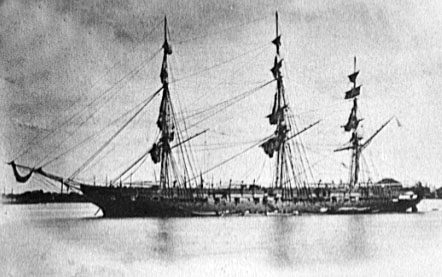
several U.S. Navy vessels. One of those ships, the steam frigate
U.S.S. Merrimack, was partially burned, but would be re-built as the
ironclad C.S.S. Virginia. Virginia militia almost immediately occupy the place.
[1, pp. 346--49; 3, p. 164; 6, p. 63; 8, pp. 279--280; 11, p. 96.] |
|||||||||
| April 22, 1861 |
Davis wires Gov. Letcher of Virginia:
"Sustain Baltimore, if practicable. We re-enforce you."
[3, p. 165.] |
|||||||||
| April 23, 1861 |
Arkansas militia seize Fort Smith and the
Federal arsenal at Little Rock.
[6, p. 64; 8, p. 282.] |
|||||||||
| April 24, 1861 | Virginia
enters into a "convention" with the Confederacy, in advance of the
secession referendum. [1, p. 360; 10, pp. 93--94; 11, p. 83; text of this "convention" is here.] |
|||||||||
| April 27, 1861 |
President Lincoln extends the blockade
of the Southern coast to include Virginia and North Carolina.
[6, p. 66; document is here.] |
|||||||||
| May 1, 1861 |
The
North Carolina Legislature passes a bill calling for a state
convention, the delegates to be elected on the 15th. The Tennessee
Legislature passes a bill authorizing the Governor to appoint
Commissioners to enter into a military league with the authorities of
the Confederate States.
[1, p. 363; 8, p. 283; Edward McPherson, Political History of the United States During the Great Rebellion, 1864, President Lincoln writes to Gustavus Fox about the failure of the Sumter expedition. [3, p. 174; Basler, Collected Works of Abraham Lincoln. Vol. 4 [Mar. 5, 1860-Oct. 24, 1861, pp. 350--51; full document is here.]
|
|||||||||
| May 6, 1861 |
Arkansas secedes.
[1, p. 365; 6, p. 70; 7, p. 251; 8, pp. 282; 10, p. 106; McPherson, The Political History During the Great Rebellion, 1864, |
|||||||||
| May 7, 1861 |
The
Tennessee Legislature, in secret session, ratifies the alliance
with the Confederacy authorized on May 1. In addition, a
Declaration of Independence and Ordinance dissolving the relations
between Tennessee and the United States, and an ordinance adopting and
ratifying the Confederate Constitution, were passed; these latter two to be voted on by the people on June 8th.
[1, pp. 364--65; 6, p. 71; 7, p. 251; McPherson, The Political History During
the Great Rebellion, 1864,
|
|||||||||
| May 21, 1861 | North Carolina secedes. [1, p. 363; 6,
p. 76; 7, p. 251; 8, p. 283; 11, pp. 104--05; McPherson, The Political History During
the Great Rebellion, 1864,
|
|||||||||
| May 23, 1861 |
Virginia's referendum on secession passes,
126,000 to 20,400.
[1, p. 332; 6, p. 77; 8, p. 280; 10, p. 93.] Colonel Elmer
Ellsworth of the New York Fire Zouaves is killed by James T. Jackson after removing a Confederate
flag from the Marshall House, an Alexandria hotel owned by Jackson, who is himself immediately killed by one of Ellsworth's men. Ellsworth becomes one of the first Northern "heroes" of the war that is just beginning.
[1, pp. 390--92; 10, pp. 145--46; 11, pp. 113--14; for a "deep dive" on Ellsworth see this book.] |
|||||||||
| June 3, 1861 |
The "Little Giant," Stephan A. Douglas,
dies. [1, pp. 392--94; 6, p. 82; 8, p. 274; 10, pp. 149--50.] Federal troops in western Virginia soundly defeat a Confederate force near
Phillipi. This is very instrumental in the movement to create a
separate state of West Virginia.
[1, pp. 406--07; 6, p. 82; 11, pp. 143--44.] |
|||||||||
| June 8, 1861 |
Tennessee secedes; the vote in the
referendum is 105,000--47,000.
[6, p. 83; 8, pp. 282--83; 10, pp. 105--06.] |
|||||||||
| June 10, 1861 |
The Battle of
Big Bethel takes place on the Virginia Peninsula. The
Civil War has truly begun.
[1, pp. 436--37; 6, p. 84.] |
Back to Civil War Chronologies (Main
page)
Date of last
revision: January 12, 2025.